
How Do You Choose the Best Coilovers for Your Honda S2000?
Damper-Length-Adjustable, Spring-Platform-Adjustable and Stock-Style Suspension Designs Explained
Part of our Honda S2000 Restoration & Tuning Journal Series
What Suspension Is Your S2000 Riding On Today?
Has an MOT test flagged a leaking or deteriorated shock absorber? Has the ride become harsher? Does the car continue moving after a bump, or has a new noise appeared from the suspension?
When symptoms are obvious, the problem is relatively easy to recognise.
There is another situation we see regularly among used S2000s in the UK: the car was already fitted with coilovers when it was purchased, but no meaningful record came with them.
When were they fitted, by whom and for what purpose? How many miles have they covered? Have they ever been overhauled? Why are the ride height and damping set where they are now?
Even if nothing looks visibly wrong, there is no reliable baseline from which to judge the condition of the suspension when none of those questions can be answered.
An ageing original suspension and an undocumented set of coilovers are therefore problems that deserve the same attention if the aim is to enjoy an S2000 for many more years.
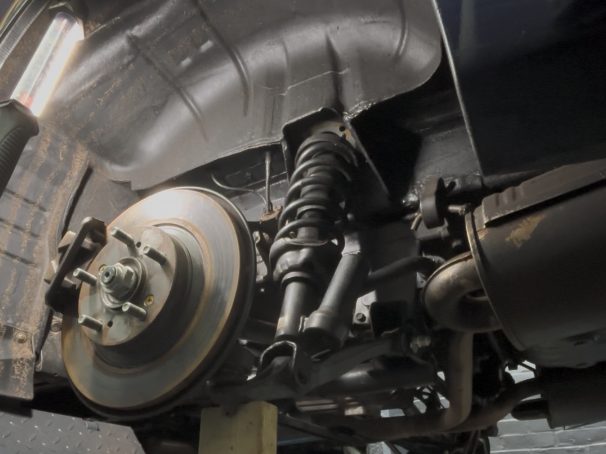
The rear damper on a customer’s S2000, which caused the vehicle to fail its MOT due to an oil leak.
Did Our Previous Article About Springs Help?
In our previous article, ‘How Can Stiffer Springs Make an S2000 Feel Calmer?’, we used our demonstrator S2000 to explain a change from the Eibach springs supplied with the Öhlins kit — 11 kgf/mm at the front and 7 kgf/mm at the rear — to Suspension Plus UC-01 springs rated at 12 kgf/mm and 8 kgf/mm.
On paper, both ends became stiffer. Yet spring-rate figures alone cannot tell us how the car will actually ride or move.
Did that article give you a more useful way to think about the springs already on your car, or the suspension you may choose next?
Today we will look from the same perspective at the shock absorbers that receive and control the movement of those springs.


The same Öhlins DFV dampers with Eibach and Suspension Plus UC-01 springs—the comparison covered in our previous article.
What Do We Actually Mean by “Coilover”?
When people hear the word “coilover”, many immediately picture suspension designed to lower a car.
In Japanese we call it 車高調 — usually written for English readers as “Sha-koh-cho”. The word is short for ride-height-adjustable suspension. There are many types, many prices and substantial differences in quality and service life.
In Britain, however, “coilover” literally describes a coil spring arranged around a shock absorber. In that sense, the original S2000 suspension is also a coilover.
In everyday Japanese usage, shakōchō means a suspension kit whose ride height can be adjusted. But does the ability to alter ride height make every system fundamentally the same?
Some change height by moving the lower spring seat. Others alter the length of the shock body so that ride height can be set without changing spring preload or damper stroke.
If we place all of them under one convenient word, “coilover”, we lose sight of what each system actually adjusts — and what may be compromised in the process.
So today, let us revisit the structures and characteristics behind the familiar terminology.
A Quick Refresher on Shock Absorber Types
Öhlins Japan classifies shock absorbers from three different perspectives. It is a particularly clear framework, so we will borrow it here.
1. How Ride Height Is Adjusted
The three categories are full-length adjustment, threaded adjustment and standard-shape suspension.
With a full-length system, the lower bracket moves to alter the overall length of the shock absorber without changing spring preload. Ride height can therefore be adjusted with less effect on available damper stroke.
A threaded system changes ride height by moving the lower spring seat. Ride-height adjustment and spring-preload adjustment take place at the same point.
A standard-shape system is close to the original suspension layout. It normally offers no ride-height adjustment, although a design that lowers the car by around 10 mm is common.
2. Upper Mount Types
Next are pillow-ball mounts, rubber mounts and reuse of the original mount.
A pillow-ball mount uses a metal spherical joint to reduce unwanted geometry changes. The response becomes more direct, although noise and vibration are also transmitted more readily.
A rubber mount sandwiches the upper-mount plate in rubber. It absorbs vibration and noise, preserving more road comfort.
An original mount means exactly that: the vehicle’s factory upper mount is reused. For the Honda S2000, the stock upper mounts have rubber bushes sandwiching them.
3. Conventional and Inverted Dampers
In a conventional damper, the cylinder sits below and the piston rod extends upwards. Because the S2000 uses double-wishbone suspension, conventional dampers are the norm.
In an inverted damper, the cylinder sits above and the downward-facing piston rod is enclosed by an outer case. This can increase rigidity while reducing unsprung weight, and the arrangement is used mainly with MacPherson-strut suspension.
Three ways to classify shock absorbers: ride-height adjustment method, upper-mount design and damper orientation. Based on illustrations from the Öhlins Japan 2026 catalogue.
You will probably have heard all of these terms before.
But when choosing suspension, did you compare these three axes separately? Did you look beyond the name and price to consider how the structure would affect ride height, stroke, comfort and response?
A full-length body, pillow-ball mounts and adjustable damping may appear to form a superior specification. But do they automatically make the best suspension for every S2000? Conversely, does a threaded body or an original upper mount necessarily indicate an inferior product?
These classifications describe structure, not quality. Internal design, materials, manufacturing accuracy, durability and rebuild support can create very different products — and very different prices — within the same structural category.
With that in mind, let us compare the S2000 suspension currently available to UK owners, adding damping-adjustment method and spring rate to the three classifications above.
The Current UK Market for S2000 Suspension
The following products are arranged by UK retail price and compared using VAT-inclusive product prices only. Prices were checked on 5 September 2026.
The table immediately shows that price does not rise in a simple line with the number of visible features.
At around £1,000, there are already products offering full-length ride-height adjustment and adjustable damping. Bilstein and KW, meanwhile, offer more expensive systems that retain threaded adjustment or the original upper mounts.
A higher spring rate does not automatically mean a higher price, and more adjustment does not automatically make a product suitable for every S2000. Internal design, intended use, durability and long-term support all sit beyond the columns of this table.
Three Suspensions on Our Demonstrator S2000
Our demonstrator is a 2005 UK-model S2000, purchased in 2021 at 75,000 miles. Since then, it has allowed us to experience three very different suspension choices.
Original Honda Suspension
The car arrived on its original Honda suspension: a non-adjustable, stock-style, conventional system using the original upper mounts, with their metal plates sandwiched by rubber bushes. Honda determined the relationship between ride height, stroke, spring and damping for the S2000 as one complete package.
However good that original design may have been, shock absorbers and rubber components are affected by age and mileage. A good design when new and the same performance twenty years later are two different things.
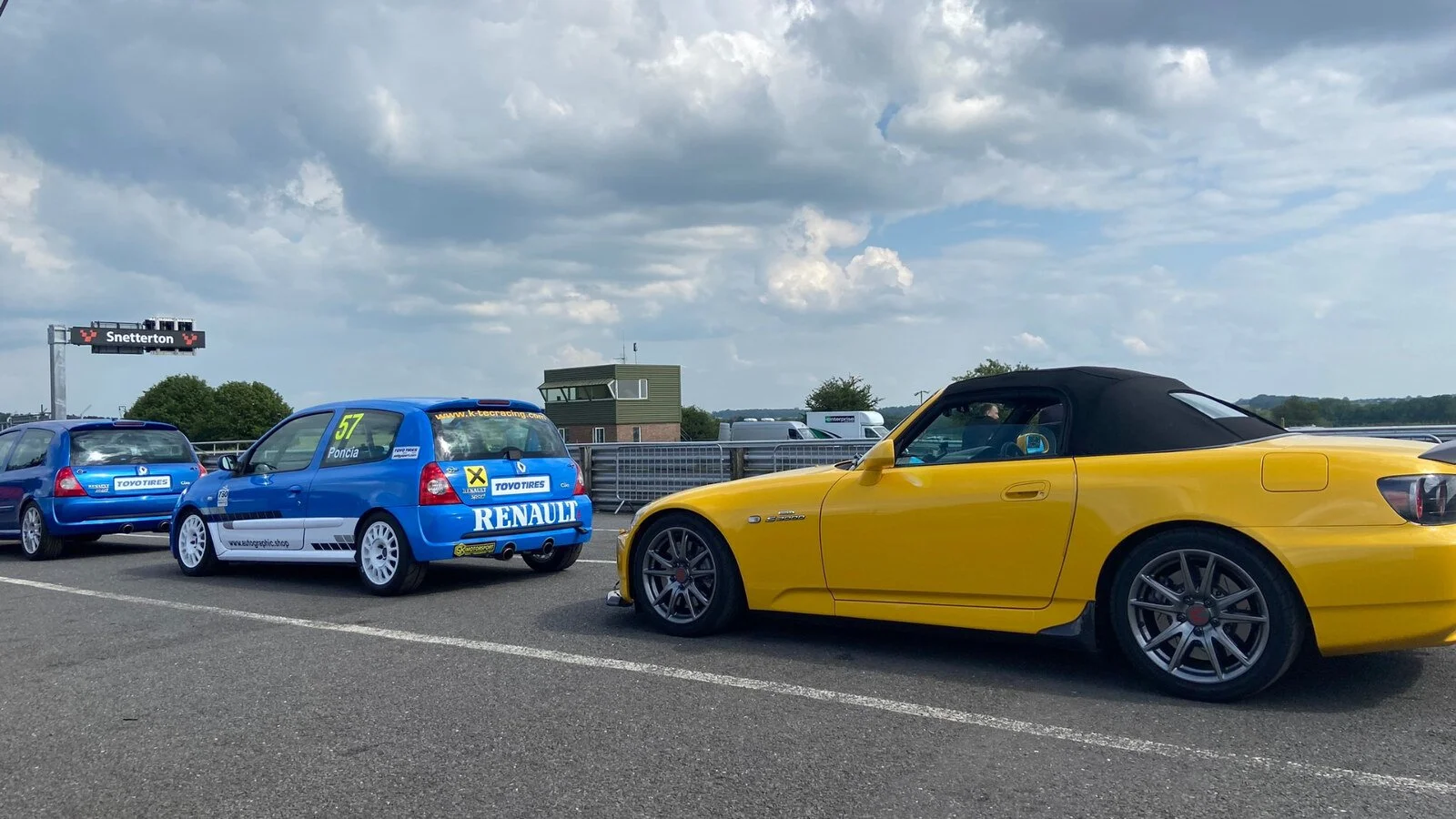
There was no obvious fault, but after 120,000 km the sealed oil would inevitably have aged, while the damper bodies had also lived through British winters and road salt. We initially took the car to Snetterton Circuit on its original suspension, using the experience as our baseline before introducing coilovers.
Bilstein B16 PSS9
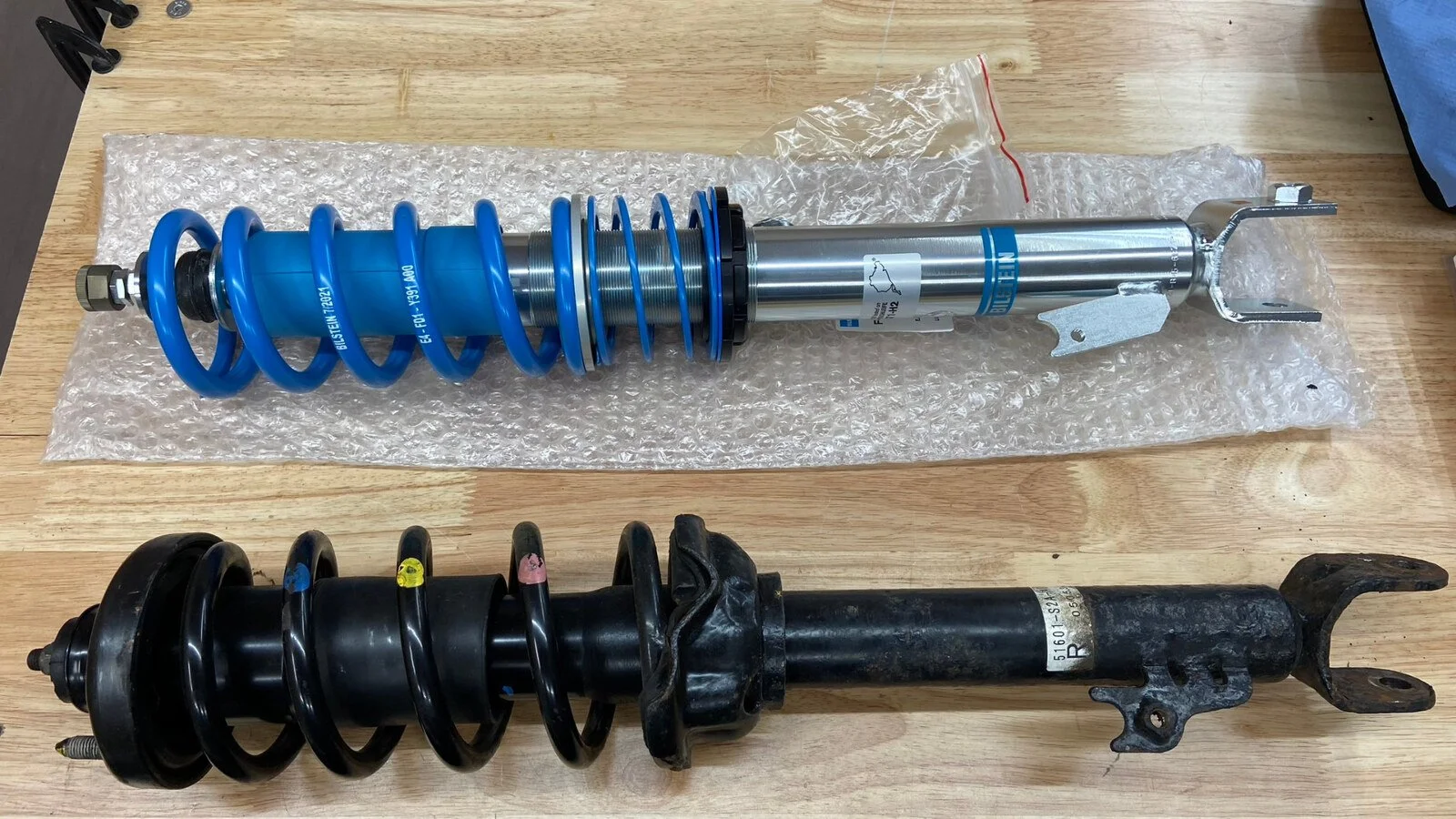
In 2023, we chose Bilstein B16 PSS9 to lower the car by approximately 25 mm. From a Japanese point of view, Bilstein was a trusted name and the price sat within a range that a broad group of owners could realistically consider.
The B16 adjusts ride height by moving the lower spring platform. It reuses the original upper mounts, while one adjuster changes compression and rebound together. We renewed the rubber components around the upper mounts at the same time.
The car was successfully lowered to the height we wanted, and we used the B16 for approximately 5,000 miles. It was not removed because it failed or reached the end of its life.
The limitation became clearer when we began looking beyond lowering the car and towards developing its suspension for circuit use.
Ride height and maximum damper extension are not the same thing. On the B16, moving the spring platform changes the position of the spring, but the overall installed length of the damper remains fixed. We could alter the ride height, but we could not shorten the damper independently or set its length separately from the spring.
This became particularly visible whenever the car was raised on the lift. The suspension extended substantially, much like the original Honda system.
That observation does not mean that a suspension which extends less on a lift must perform better on a circuit. Droop travel remains necessary, and too little can reduce tyre contact over crests, kerbs and uneven surfaces. The important point was that the B16 did not allow us to define the relationship between ride height, spring preload and overall damper length independently.
For ordinary road use and straightforward lowering, this may present no problem at all. For our combination of road use, circuit driving and continued suspension development, it became a limitation.
The B16 had done the job for which we originally bought it. We had simply reached the point where our objective had changed.
Öhlins DFV + Suspension Plus
In 2024, we replaced the B16 with the Öhlins DFV recommended by Mr Obara of CSO.
The DFV combines damper-length ride-height adjustment, pillow-ball upper mounts and conventional dampers. Because its installed length can be adjusted through the lower bracket, ride height and spring preload can be considered separately.
This does not automatically preserve the correct amount of bump and droop travel. Those still have to be measured and set correctly. The advantage is that the structure gives us the means to consider each element separately, rather than accepting one fixed relationship.
That structure made complete sense in my own head. I could determine the target setting in one attempt, and the work became substantially easier and more repeatable.
We first used the Eibach springs supplied with the Öhlins kit — 11 kgf/mm at the front and 7 kgf/mm at the rear — before moving to Suspension Plus UC-01 springs rated at 12 kgf/mm and 8 kgf/mm. Compatible straight springs can therefore be changed as the setup develops.
The pillow-ball mounts, published spring rates and freedom to select compatible springs also gave us a clearer basis for circuit development. Instead of simply lowering the car, we could begin treating ride height, damper length, spring preload, spring rate and damping as parts of one complete setup.
Öhlins DFV sits in a higher budget bracket, but for our use, its freedom of adjustment and ease of setup justified the additional investment.
This history should not be read as a simple ranking in which B16 is better than Honda, and DFV is better than B16.
The original Honda suspension was designed as a complete road-car package. The B16 gave us the lower ride height we wanted at an accessible price. The DFV became the more suitable platform when our objective moved towards genuine suspension tuning and continued circuit development.
The correct choice therefore depends on what you are asking the suspension to do.
Can You Still Buy Original Honda S2000 Suspension?
We are being asked this question with remarkable frequency. The answer is neither a simple yes nor a simple no.
In October 2024, we investigated Honda supply for a customer seeking original suspension for a 2006 UK-model S2000 - Your S2000 Has Failed Its MOT. What Happens Next?
At that time, all four complete shock-absorber assemblies — left and right, front and rear — had been discontinued, with no stock held at Honda’s central warehouse in Suzuka, Japan.
The individual components, including shock absorbers, springs, upper mounts, rubber seats and bump stops, were still available.
It was therefore possible to recreate new original suspension, but not to remove four complete assemblies from boxes and bolt them straight onto the car. Each component had to be sourced separately and built into a complete suspension assembly. Our estimate came to approximately £2,500. For an owner committed to original Honda parts, that is not necessarily an expensive purchase. With thorough corrosion protection, it should serve properly for the next 100,000 miles.
Used suspension is another possibility. But without knowing the donor car, mileage, storage conditions, oil leakage or remaining damping performance, the result may simply be replacing one old original suspension with another old original suspension.
The original specification can still be restored. It is simply no longer the easiest or least expensive route — and with the same budget available, another option may become tempting. That depends entirely on the owner’s values and goal.
What Would You Choose with a £2,500 Budget?
If you had approximately £2,500 available for the suspension of your S2000, what would you choose?
Collect new Honda components and recreate the original system. Choose Bilstein or TEIN and use the remaining budget for fitting, rubber components and alignment. Move towards track use with HKS or KW. Or spend almost the entire allowance on Öhlins DFV.
The right answer changes according to how you want to own and use the car.
If originality matters most, there is genuine value in spending £2,500 on Honda components. If you want to tailor ride height, preload, damping and spring rate around your own purpose, the same money can instead buy an adjustable suspension system.
But buying an expensive suspension is not the end of the story.
Öhlins DFV can be dismantled and overhauled. The official Öhlins owner’s manual recommends service every 60,000 km for regular road use. For racing, the recommendation is every 15 operating hours, with an absolute maximum of 30 hours without service and an oil change.
That does not mean the product has a short life. It means that instead of discarding worn suspension, its oil and seals can be serviced and its intended performance restored for continued use.
Do you look only at the purchase price, or also at adjustment after installation, maintenance, parts support and future overhaul?
Even when the same £2,500 is spent, the value of that investment depends less on what was purchased today than on how the S2000 will be built, used and maintained from here.

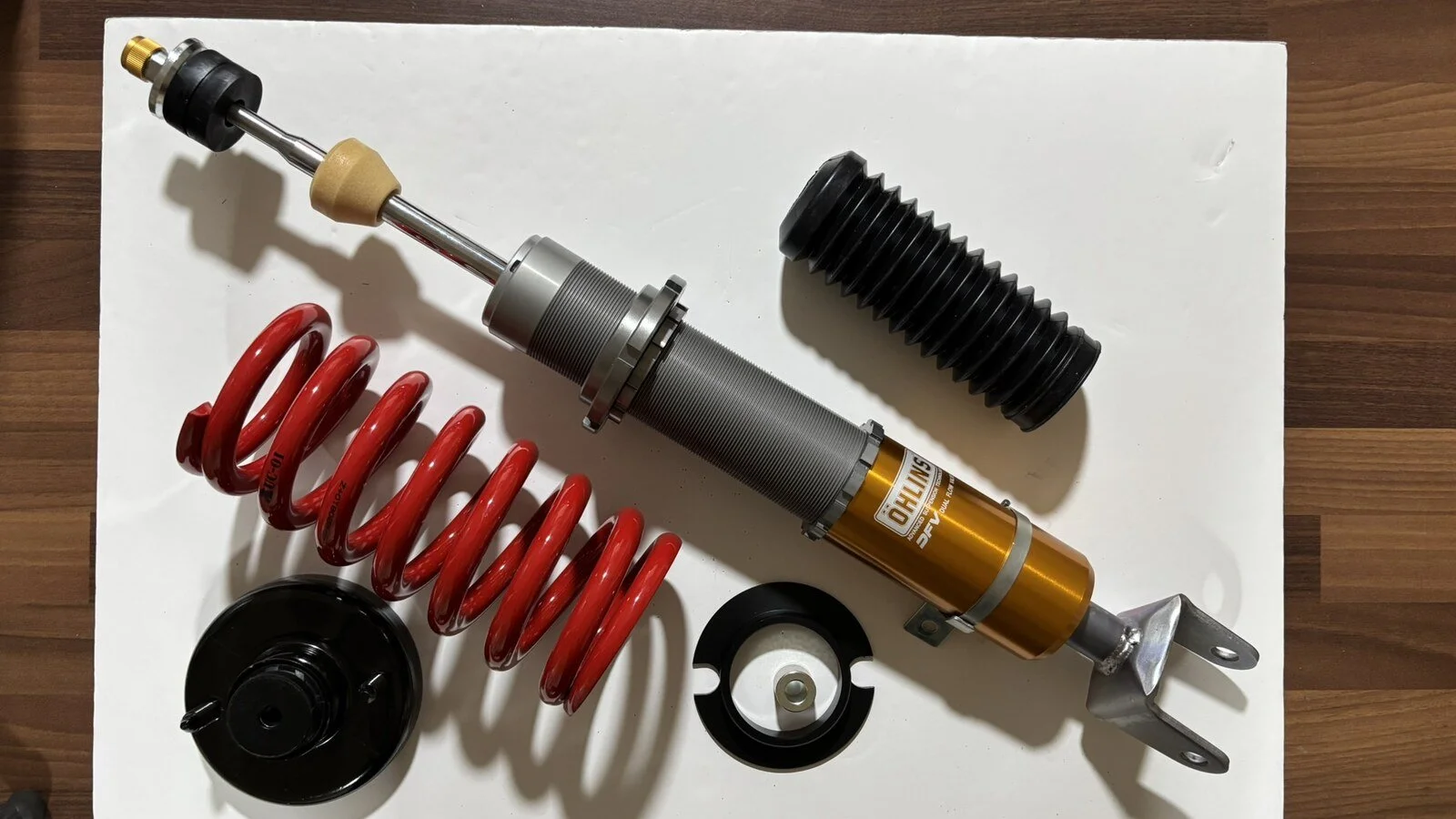
Our Öhlins DFV being assembled with Suspension Plus UC-01 springs, with the original Eibach springs in the background—one suspension system, developed around a changing purpose.
Talk to Us About Your S2000 Suspension
If you are interested in recreating original Honda suspension, fitting Öhlins DFV, selecting Suspension Plus springs, or evaluating and adjusting the suspension already on your S2000, please contact TR Imports UK.
We will look at the condition and intended use of the car with you, then consider the suspension and setup that best suit your goal.
See the Complete S2000 Restoration
Explore the complete restoration and development of our demonstration S2000—and the workshop experience behind it: