
Let’s explore three routes in the Japanese Market with us.
Our Wednesday JDM Import Journal series is designed to help you understand how to import a New Copen and how to build a realistic budget. By now, have you got a feel for the difference between auction prices and retail prices?
Two articles ago, we looked at the grading system and damage diagrams used at Japanese vehicle auctions. Even a car with a high grade cannot be understood completely from the auction sheet alone.
Last time, we moved into the retail market on Goo-net. Together, we chose the face, colour and gearbox of your ideal Copen, then added a budget and discovered where compromises might be needed.
Today, let us try a different angle: deliberately buying a car with a problem.
We will widen the search to cars advertised with repair history, cars graded R at auction, and accident-damaged cars offered before repair. Could one of these routes be a good investment once we understand what we are actually buying?
This time, instead of looking for a problem-free Copen, we will examine three ways of buying a problem Copen with our eyes open.
Who Buys a Car with a Problem?
First, let us imagine who might buy a repaired or accident-damaged car, and why.
The clearest example is somebody trying to reduce the purchase price. They accept accident or repair history in exchange for paying less than they would for a problem-free car of a similar age, mileage and grade.
Another buyer has already decided exactly what they want: perhaps a five-speed manual, a particular colour or face, or nothing other than a GR Sport. If no clean-history car matches, they widen the search to repaired cars.
A capable DIY repairer, or somebody with a trusted bodyshop, may also see value here. If the car remains affordable after parts, workshop facilities, technical work and labour are included, buying the problem may make sense.
Then there is the buyer who already intends to modify the car. If a bumper or bonnet they planned to replace is damaged and that lowers the purchase price, the problem may actually be convenient.
Keep those four people in mind as we continue.
Three Routes to a Copen with a Problem
Before analysing prices, let us look at the three places where these cars can be found.
1. A “repair history” car advertised on Goo-net
The easiest route is to use the “repair history: yes” filter on Goo-net and similar Japanese retail marketplaces. As always, search the Japanese site itself rather than being redirected to an English translation site.
The amount of repair information varies from dealer to dealer. You can ask whether photographs from the accident or records of the repair still exist, but the advert will usually show only the finished car.
2. An R-rated car at a Japanese vehicle auction
The second route is to find a car marked R on the auction sheet. Thinking of it as “R for Repair” makes the label easy to remember.
A dealer may buy an R-rated car, prepare it for retail and later advertise it as a repair-history car. At auction, you see the vehicle one step earlier — after repair, but before retail preparation.
3. An accident-damaged vehicle auction
The third route is an auction section devoted to accident-damaged vehicles. An R-rated car has already been repaired; an accident vehicle is offered before repair.
You can see the car in its damaged state, which makes the direction and visible extent of the impact easier to understand. For readers who genuinely enjoy repair work, this may be the most tempting catalogue of all.
From accident vehicle to R-rated auction car and, after preparation, a retail repair-history car.
“Repair History” Does Not Simply Mean “A Car That Had an Accident”
What does the “repair history” filter on Goo-net actually mean?
In Japan, the term is not triggered merely because a car had an accident or because a panel was replaced. The judgement concerns damage to specified structural parts of the body and whether those parts have been repaired or replaced.
A replacement bumper, wing or door will not normally create repair history if the defined structure was not damaged. Conversely, a visually modest accident may count if a specified structural member was damaged and repaired.
The display is not a definition invented by Goo-net. It sits within Japan’s fair-competition rules for motor-industry advertising, while the recognised vehicle-appraisal criteria are used to decide whether the car has repair history.
But will a Goo-net advert tell us where the damage occurred, how severe it was, which parts were changed and how the repair was carried out? Probably not. In most cases, we see only the car after repair.
So, what does that do to the price?
Around one in seven first-generation Copens was marked as having repair history. For the LA400 generation, it was around one in twenty.
We selected three pairs of LA400 Copens with broadly similar age, grade, transmission and mileage.
Across the three comparisons, the repair-history cars were advertised for around 14–15% less.
Honestly, that was not as much of a saving as I expected. What do you think? Did it feel sufficiently affordable?
By the time an accident vehicle has been repaired, passed through auction, prepared by a dealer and advertised on Goo-net, it has reached the “After Repair, After Preparation” stage. Repair and preparation costs have been added back into the price, so perhaps the gap naturally narrows.
I felt slightly disappointed — and curious enough to take a short detour into the British market. Please come with me.
Is a UK CAT Vehicle the Same as Japanese “Repair History”?
Let us make a brief detour into the UK market.
On Auto Trader, we often see cars described as Cat S or Cat N. The labels may look similar to Japanese repair history, but they do not mean the same thing.
The UK categories apply after an insurer has declared a vehicle a total loss — a write-off. The Association of British Insurers’ Salvage Code of Practice divides those vehicles into four categories.
The retail candidates are therefore Cat S and Cat N. Cat A and Cat B vehicles cannot return to the road.
Cat N is still a write-off. It does not automatically mean a light accident. Steering, suspension, brakes or electrical systems may have suffered serious damage even though the structure was not damaged.
The categories are not a ladder of damage severity. They first depend on the insurer’s economic write-off decision, then describe whether the damage is structural.
Japanese repair history begins with defined structural repair. Cat S and Cat N begin with a write-off decision. That leads to an important gap: Auto Trader has no filter for a repaired car that was never written off, while Japan has no equivalent filter for a written-off car that later returned to the road.
Enough definitions. Let us compare prices.
There were too few Copens in Britain to build several close pairs, so we used 2019 Ford Fiestas with similar trim, engine, body style and mileage.
The three CAT cars were advertised for around 23–36% less, with a simple average discount of about 28%.
That is substantially more than the 14–15% gap found in the Japanese Goo-net comparisons. Perhaps Cat S and Cat N write-off history carries a heavier psychological burden for British buyers than Japanese repair history does for buyers in Japan. That is my view, at least. What do you think?
More importantly, Britain lacks a definition for “repaired but never written off”, while Japan lacks a definition for “written off and later returned to the road”. Let us call that a draw and return to Japan.
Is an R-Rated Auction Car Actually Cheaper?
Back in Japan, let us move one stage earlier and examine R-rated cars at vehicle auction.
On Goo-net, our first view is the repaired and retail-prepared car. At auction, we see the vehicle before the dealer’s preparation and we can read the auction sheet.
The first example is a 2015 Copen Cero with 78,500km, overall grade R and interior grade B. The sheet records repair history, work to the right floor and replacement of a right-side panel.
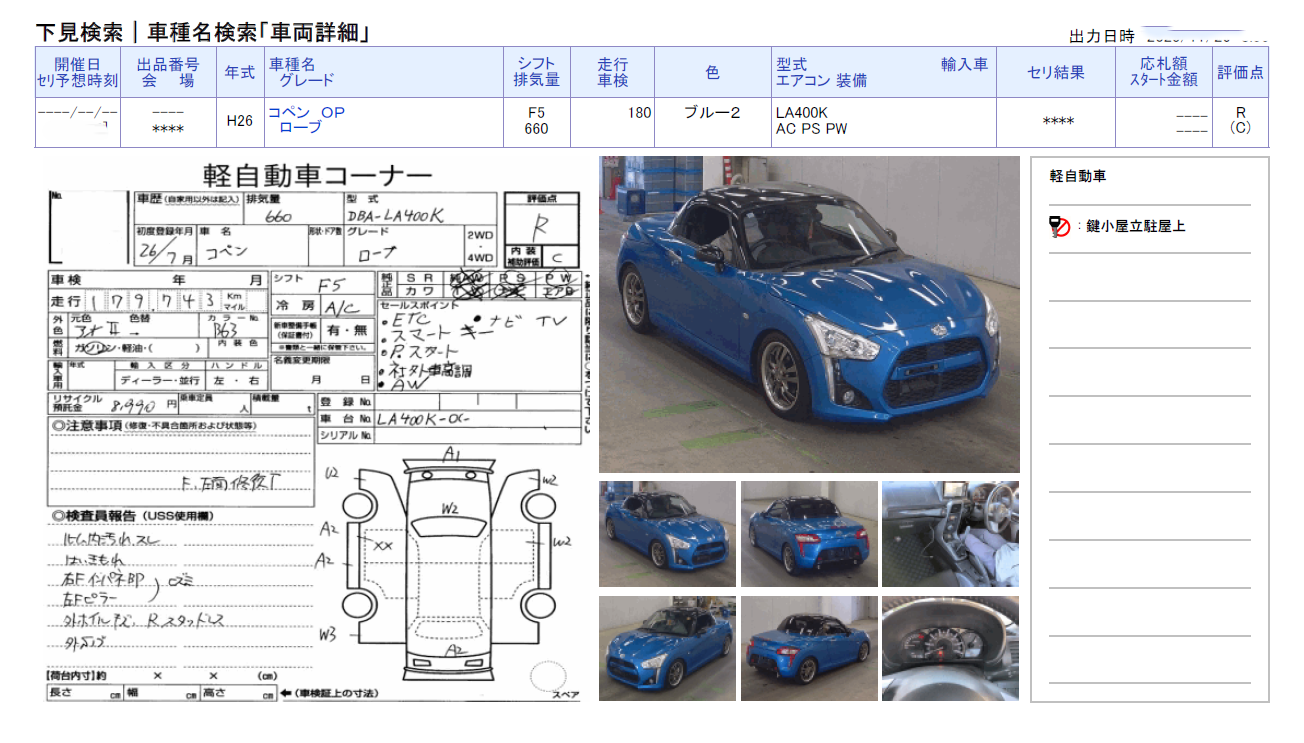
The second is a 2014 Copen Robe with 179,500km, grade R and interior grade C. The sheet records exterior marks, evidence of repair and the inspector’s observations.
You would not identify structural repair simply by looking at the listing photographs. The structural work may be complete while bodywork and exterior finishing remain imperfect. Once we read the sheet, the cars look rather more “as expected”.
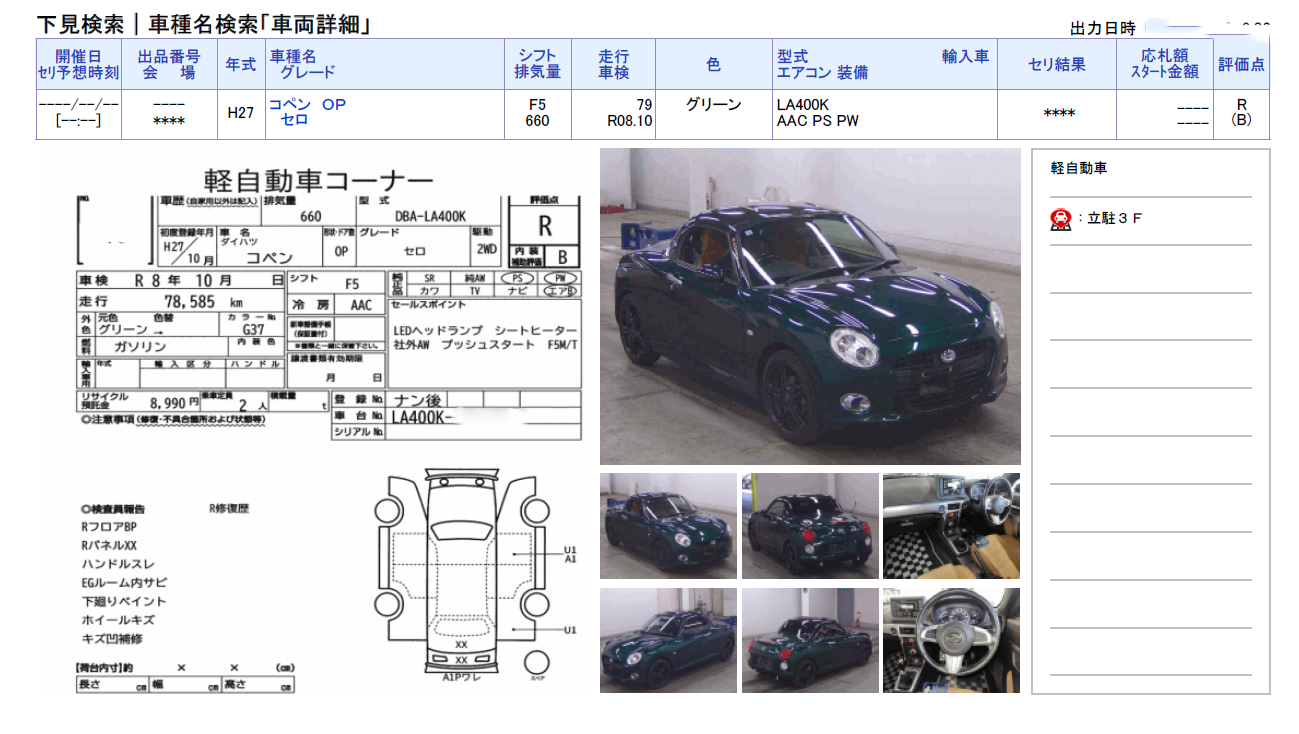
Left image: Auction example 1 — 2015 Copen Cero, grade R / interior B
Right image: Auction example 2 — 2014 Copen Robe, grade R / interior C
Both cars sold for roughly ¥500,000. Was that materially below the price of a normal-grade car?
We also saw a 2015 Robe with 173,500km and grade 3.5B. It also sold for roughly ¥500,000. Yes, really.
My excuse is that the 179,500km R-rated car had coilovers and a black interior. The individual value of those parts may have absorbed the difference against a standard car with a beige interior. That is also the joy of an auction: age, mileage and grade never tell the whole story.
Our disappointing Goo-net result may therefore begin one stage earlier. In this example, the R-rated auction car did not show a dramatic discount either. Sorry.
Even so, I still believe price is the main attraction of searching among R-rated cars. If you are lucky, an unusually specified car or one carrying valuable options may attract little competition.
I am still not satisfied, so please stay with me for one final example.
Is an Accident Vehicle the Real Bargain?
The final route is the accident vehicle before repair.
Our example is a 2014 LA400K Copen Robe with a five-speed manual gearbox and approximately 60,000km.
There is no normal auction grade. The inspection area is marked invalid and the report states that the front and running gear remain in accident condition. This is not a normal used car waiting to be assessed; it is being offered with its front and suspension damage still present.
The bonnet and front bumper area are visibly out of position. That does not mean the repair ends with replacing the visible panels. Suspension, subframe, steering, cooling system and structure all require inspection. An engine that starts is not the same thing as a car that can drive safely and straight.
But the accident vehicle gives us one thing the repaired cars cannot: the pre-repair state. We can see the direction of the impact, dismantle the car ourselves and decide which parts and repair methods are required.
Accident vehicle example — 2014 Copen Robe 5MT, approximately 60,000km
This car sold for roughly ¥500,000. Another ¥500,000 car? Yes — lower-grade Copens do have a habit of climbing towards that area.
The useful comparison is different. A 2015 Robe with approximately 60,000km and grade 4.5C sold around the same period for about ¥1.1 million. That gap is substantial. Here, “cheaper” feels justified.
The difference is not free value. An accident vehicle may not be driveable and can require specialist transport. That cost must not be forgotten.
Nevertheless, of the three Japanese routes examined here, the accident vehicle produced the first discount I could really feel.
Whether you should buy it depends on your ability: judging the damage before repair, choosing the right end goal and estimating the true repair cost.
Or perhaps it is time to start a BREAKING business.
Who Is a Problem Copen Affordable For?
We have now followed three routes to a problem Copen.
Goo-net is the easiest, but the car has already reached “After Repair, After Preparation”. Our three pairs were only 14–15% cheaper — less affordable than I expected.
An R-rated auction car lets us inspect the sheet before retail preparation. Yet our R-rated Robe and a comparable 3.5B car both sold for around ¥500,000. Individual value — colour, interior, gearbox, coilovers and options — can absorb the expected repair-history discount.
Then came the accident vehicle: roughly ¥500,000 against about ¥1.1 million for a similar-age, similar-mileage 4.5C car. At this stage the price difference was unmistakable.
The closer we move towards the unrepaired car, the larger the potential discount. But that discount is not free. The buyer also receives the transport, dismantling, inspection, parts sourcing, repair, paint, assembly and the risk of finding more damage after work begins.
Return to our four imagined buyers. The budget buyer must calculate the completed cost. The specification hunter may find a rare combination by accepting repair history. The DIY repairer or trusted workshop may be able to use the accident-vehicle discount. The planned modifier may not care about damage to parts that were going to be replaced anyway.
So, is a problem Copen affordable? The purchase price alone cannot answer that question.
The more work and risk you can understand and genuinely take on, the more affordable a problem Copen may become.
Which of the three routes would you choose?
Once you know the Copen you want and the budget you have, talk to TR Imports UK. We will help you choose the right route to find it.
Discuss a Bespoke JDM Import
View LA400 Copens currently available in our UK Showroom
Or would you still like to know the costs for a good Copen?