
How Can Stiffer Springs Make an S2000 Feel Calmer?
Fit stiffer springs and the car should feel harder and more aggressive. That sounds logical.
Part of our Honda S2000 Restoration & Tuning Series

The spring rate increased from 11 to 12 kgf/mm at the front, yet the resulting character felt calmer and more progressive from the driver’s seat.
How Can Stiffer Springs Make an S2000 Feel Calmer?
Fit stiffer springs and the car should feel harder and more aggressive.
That sounds logical.
Yet something rather different happened with our Honda S2000 demonstrator.
We replaced the standard 11 kgf/mm front and 7 kgf/mm rear springs supplied with its Öhlins DFV suspension with Suspension Plus Japan UC-01 springs rated at 12 kgf/mm and 8 kgf/mm.
The numbers went up at both ends of the car.
From the driver’s seat, however, the S2000 felt calmer.
Not slower. Not softer. Not less responsive.
The transition from turning into a corner, through the build-up of lateral load, to the point where the chassis finally settles became easier to read. Once the car had taken a set, it appeared happier to remain there.
Japanese racing driver Keiichi “Drift King” Tsuchiya often uses the word odayaka when describing a car with this kind of behaviour.
It means gentle or calm—but not dull.
The movement is not abrupt. The driver can understand what the car is doing and has time to prepare the next input.
That was precisely the character we wanted.
A Finished Product in Europe, a Starting Point in Japan
The current European specification for the Honda S2000 Öhlins Road & Track DFV kit uses 110 N/mm front and 70 N/mm rear springs—approximately 11 kgf/mm and 7 kgf/mm in the units more commonly used by Japanese suspension specialists.
In the UK, the suspension is generally presented and priced as a complete package. Individual dampers and springs can be obtained as replacement parts, but the normal retail price list does not encourage the customer to begin by separating the two.
Öhlins Japan takes a different approach. Its price list distinguishes between dampers supplied on their own and packages supplied with springs.
That difference tells us something about the two markets.
In Europe, an Öhlins kit is usually regarded as a developed, ready-to-install suspension package.
In Japan, buying the dampers may be the beginning of the setting process. Drivers and specialist workshops often select the springs separately, then refine the combination around the car, its tyres, its intended use and the driver’s preferences.
The dampers may be the same, but the culture surrounding them is not.
Why We Chose Suspension Plus UC-01
We had already decided to change the springs when the Öhlins DFV suspension was selected for our demonstrator.
The choice was made following the recommendation of Mr Ohara of CSO, whose experience with the Honda S2000 has guided several parts of the car’s development.
He recommended the UC-01 competition spring manufactured in Japan by Suspension Plus.
Suspension Plus does not produce one spring and simply offer it in different rates. Its ranges are designed to have different characters. According to the company representative we consulted, the UC-01 is deliberately positioned as a low-reaction spring, while the UC-03 has a distinctly high-reaction character.
The company’s experience also extends well beyond ordinary road and track-day cars. Suspension Plus springs were adopted by the Calsonic Team IMPUL GT-R in the GT500 class of SUPER GT. Its involvement with TEAM IMPUL continues today with the TRS IMPUL with SDG Z, based on the Nissan Z NISMO GT500.
TRS IMPUL with SDG Z in the SUPER GT GT500 class. The Suspension Plus logo can be seen on the rear-wing support.
That racing connection is impressive, but it was not the reason we selected the UC-01.
What mattered was the company’s ability to give different springs deliberately different personalities.
For our S2000, we were not simply looking for the fastest initial response.
We wanted the cornering load to build progressively. Once the chassis had taken a set, we wanted it to remain stable there. From the clipping point, we wanted to unwind the steering and apply the throttle without provoking the sort of oversteer that requires a corrective steering input.
That requirement led us to the UC-01 rather than the more immediately reactive UC-03.
What Do We Mean by a “Calm-Response” Spring?
Japanese suspension discussions often use expressions that translate literally as “low reaction” and “high reaction”.
These are useful pieces of driving language, but they are not internationally standardised engineering classifications.
Translating the terms as “low rebound” and “high rebound” would also create confusion in English, because rebound normally refers to the extension side of damper control.
For this article, we will therefore use two descriptive terms:
Calm-response for the low-reaction character
Quick-response for the high-reaction character
A calm-response spring is not one that is physically slow to move.
It describes a spring whose behaviour, as part of the complete suspension system, allows the load to build in a way that feels progressive and predictable to the driver. Once the car has taken a set, it feels settled and willing to maintain that attitude.
A quick-response spring gives the driver a more immediate impression as load is applied and released. That can be valuable through short corners and rapid changes of direction, where alertness and agility are priorities.
Neither character is automatically better.
The right choice depends on the car, circuit, corner, tyres and the way the driver prefers to build and release load.
Nor are we suggesting that one loose spring takes a measurable number of seconds to compress while another moves more quickly. On a car, suspension movement results from the spring, damper, vehicle mass, suspension geometry, tyre and road input working together.
“Calm-response” and “quick-response” describe the resulting character felt by the driver, not a stopwatch test performed on an isolated spring.
Putting the Yellow and Red Springs Together
The yellow Eibach springs removed from the Öhlins kit alongside two red Suspension Plus UC-01 springs. Similar overall dimensions conceal substantial differences in construction and weight.
We still have the yellow springs removed from the S2000, together with several unused red UC-01 springs.
Although we refer to the originals as “Öhlins springs”, the yellow springs supplied with this kit were manufactured by Eibach.
Among Japanese drivers and suspension specialists, Eibach racing springs are often described as sitting around the middle of the calm-to-quick response spectrum, perhaps leaning slightly towards the quick-response side. This is an informal driving assessment rather than an official engineering category.
Suspension Plus, by contrast, describes the UC-01 as a deliberately low-reaction design.
In other words, we did more than change brand and increase the rate. We moved towards a different spring character at the same time.
Placed next to each other, the springs appear broadly similar. They are all steel coils of roughly the same free length.
Look more closely and they begin to tell different stories.
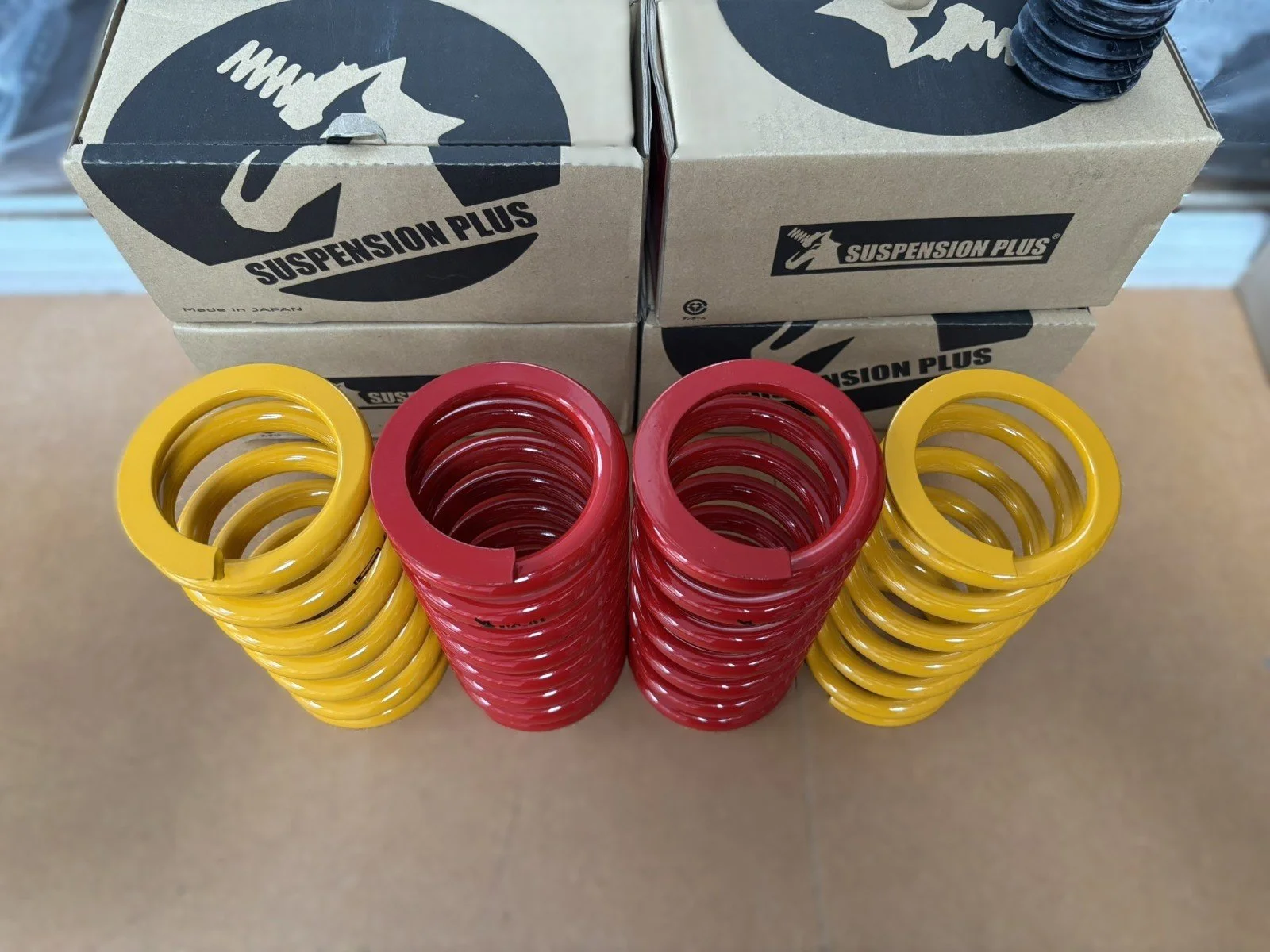
Viewed from above, the differences in wire diameter, coil arrangement and end shape become easier to see.
The wire diameters are different. The number and shape of the coils differ. Even before placing them on the scales, the difference in weight can be felt by hand.
So we measured them.
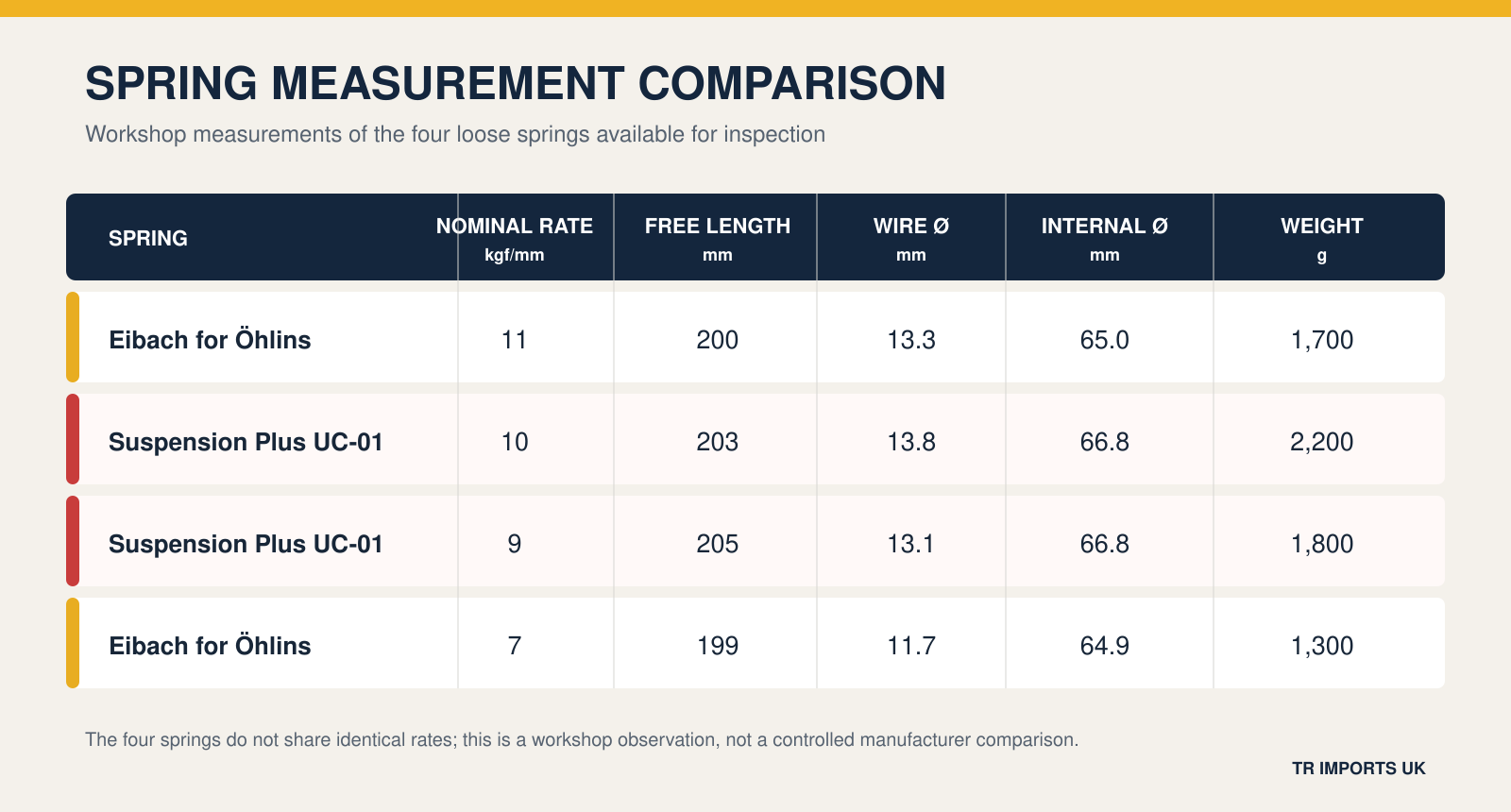
Our observed coil counts were:
Öhlins 11 kgf/mm: seven complete turns, plus approximately 30 mm at the end
UC-01 10 kgf/mm: seven complete turns, plus approximately 30 mm at the end
UC-01 9 kgf/mm: seven and a half turns, plus approximately 25 mm at the end
Öhlins 7 kgf/mm: six complete turns, plus approximately 30 mm at the end


The four loose springs photographed individually. Their different wire diameters, coil arrangements and end shapes remain visible even though their free lengths are broadly similar.
These are workshop observations, not manufacturer-specified active coil counts.
The four loose springs do not share identical rates, so this is not a controlled scientific comparison between Eibach and Suspension Plus.
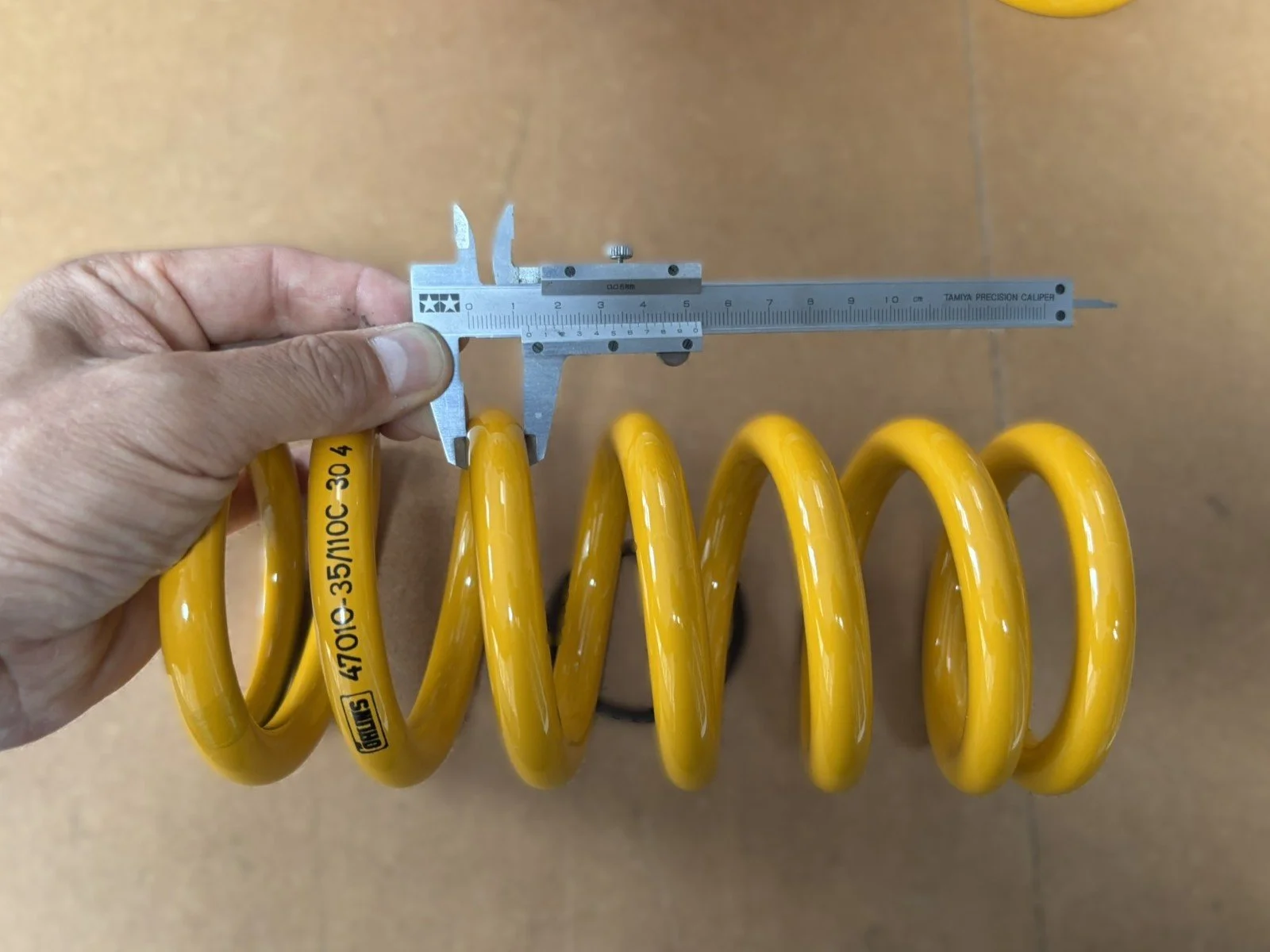

Measuring the wire diameter confirmed that the 10 kgf/mm UC-01 used thicker wire than the 11 kgf/mm Eibach spring.
The closest pairing is the 11 kgf/mm Eibach and the 10 kgf/mm UC-01.
Their free lengths differ by only 3 mm, and their observed coil counts are almost identical. Yet the UC-01 uses wire that is 0.5 mm thicker and weighs 500 g more—approximately 29 per cent heavier.
Despite that visibly more substantial construction, its nominal rate is 1 kgf/mm lower.
A thicker, heavier spring is not automatically a stiffer or more aggressive spring.
The Number Does Not Tell the Whole Story
A spring rate tells us how much load is required to compress a spring by a given distance.
It does not tell us everything about how the spring was designed to achieve that rate.
Material, wire diameter, mean coil diameter, active coil count, free length, end design and manufacturing tolerances can all contribute to the finished product.
The UC-01 uses high-tensile steel and is designed to provide substantial usable stroke, even as it approaches coil bind. Suspension Plus also describes it as combining flexibility with a strong supporting quality and resistance to sagging.
Its closed and ground ends are designed to help it reach the target rate promptly.
At first, “reaching the target rate promptly” may sound incompatible with the calm character we have described.
They are not the same thing.
One concerns the load-versus-deflection characteristics of the spring itself. The other concerns the transitional behaviour perceived by the driver once that spring is combined with the dampers, suspension geometry, tyres and vehicle mass.
Our measurements cannot prove the UC-01’s low-reaction character.
They do, however, show that two springs with nearby rates can arrive at those numbers through visibly different constructions.
The figure printed on the side of a spring does not describe its entire personality.
Why 12/8 Is Not a Universal Answer
Our demonstrator currently uses 12 kgf/mm front and 8 kgf/mm rear UC-01 springs.
This is not a recommendation for every S2000, and certainly not for every type of car.
Front-to-rear spring balance is influenced by weight distribution, suspension design, spring location, motion ratio, dampers, anti-roll bars, tyres, alignment, intended use and the behaviour the driver wants from the car.
The rate printed on the spring is not necessarily the effective rate experienced at the tyre contact patch.
Suspension geometry and the relationship between wheel movement and spring movement produce what is commonly called the wheel rate. Two cars fitted with springs bearing the same number may therefore feel entirely different.
A car with a completely different layout from an S2000 may use a rear spring rate equal to—or considerably higher than—its front rate.
Moving our 12/8 combination to another vehicle would not reproduce the same character.
The S2000 does not feel calm simply because the numbers are 12 and 8.
It feels calm because those springs work as part of this particular combination of chassis, dampers, tyres, alignment and driver intention.


The rear UC-01 springs form only one part of the demonstrator’s complete chassis setup. Spring rate cannot be separated from suspension geometry, dampers, tyres and alignment.
What We Feel on the Road and at Snetterton
On the road, the S2000 does not feel as though it simply uses soft springs to absorb every input.
There is support and control, but the body’s response is not abrupt. The driver has a clearer sense of what is happening and where the chassis is within the load-transfer process.
The same quality is valuable at a fast, long circuit such as Snetterton.
The car does not rush through the transition as lateral load builds. Once it has taken a set, it remains composed through a longer corner rather than appearing eager to release that load partway through.
That gives the driver time.
At the clipping point, the next phase begins: unwind the steering and introduce the throttle.
Our aim is not to provoke oversteer and then catch it with opposite lock. It is to coordinate steering release and throttle application so the car can accelerate away with zero counter-steer.
The UC-01 does not prevent oversteer for the driver.
What it provides is a progressive, readable platform through the build-up, retention and eventual release of cornering load. The driver still has to make the correct inputs, but the car gives those inputs time to work.
That is what we mean when we call it calm.
Our S2000 demonstrator at Snetterton. On a wet circuit, progressive and readable load transfer becomes more valuable than an aggressive initial response.
Buying Expensive Coilovers Is Not the End of the Story
The Öhlins DFV is an excellent damper, capable of providing impressive performance on both road and circuit.
But even an expensive coilover kit cannot include one spring specification that is perfect for every car, tyre, road, circuit and driver.
That does not mean everyone should immediately replace the springs supplied with their suspension.
A standard package has been developed to work across a broad range of uses. Moving away from it should require a better reason than simply wanting the car to be stiffer or lower.
Where in the corner do you want the car to move?
How do you want the load to build?Once the chassis has taken a set, how long do you want it to remain there?
How do you want the car to make the transition from cornering to acceleration?Choosing a spring is not simply choosing a number.
It is choosing how you want the car to move.
We did not select the softest spring available.
We selected the spring character that could give our S2000 the particular kind of calmness we wanted.
See the Complete S2000 Restoration
Explore the complete restoration and development of our demonstration S2000—and the workshop experience behind it:
