
Auction Copen or Retail Stock: How Much Should You Budget to Import from Japan?
How to read Japanese auction prices, retail prices and the preparation budget behind the finished car
You have decided that you want a yellow LA400 Copen from Japan.
Perhaps it should be a Cero. Perhaps you want the sharper GR Sport. Or perhaps an early Robe would leave more of your budget available for the parts you intend to fit later.
Then the prices begin to appear.
One car sells at auction for less than ¥1 million. Another apparently similar Copen is advertised by a Japanese dealer for ¥1.5 million. A low-mileage GR Sport is over ¥2 million. At first, the auction car looks like the obvious bargain.
But are those prices really describing the same thing?
The auction result is the price at one stage of the car’s journey. A Japanese retail price represents a later stage, after a dealer has decided what must be done before offering the car to a customer. Neither figure, on its own, tells a UK buyer how much budget will ultimately be required.
In this article, we use ten recent auction results for yellow LA400 Copens and compare selected examples with Japanese retail stock. The purpose is not to declare that auctions are cheap or dealers are expensive. It is to show how we read the figures before advising a customer where the budget should be spent.

What Is an Auction Car?
Japanese vehicle auctions receive cars from many sources. One route we regularly encounter begins with a part-exchange at a Japanese dealership.
If the dealer keeps that part-exchange and prepares it for its own forecourt, it may avoid some of the transport and auction costs involved in moving the car through the wholesale market. Keeping it can therefore make commercial sense.
However, the dealer may decide that the work required does not suit its retail standards, available workshop time, stock profile or commercial model. In that situation, recovering its position by sending the car to auction can be the more rational strategy.
That does not mean every auction car is a problem car. Dealer part-exchanges are only one source among many, and some very good cars are sold through auction. It does mean that an auction vehicle may be entering the market before anyone has completed the work required to turn it into a retail-ready car.
This distinction matters. An auction is not simply a secret shop where the same finished cars are sold more cheaply.


Ten Yellow Copens: The Auction Starting Point
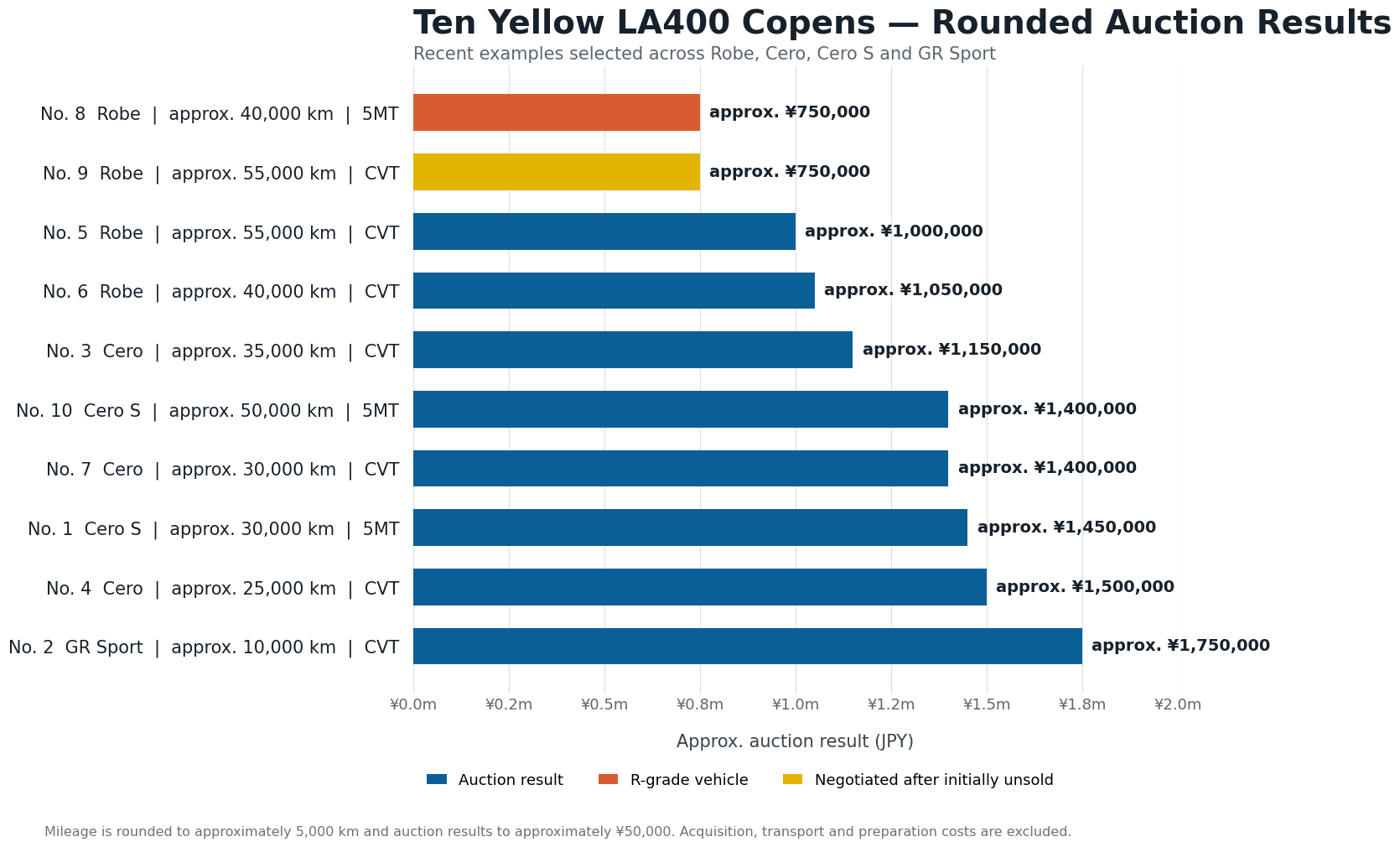
To keep the comparison visually consistent, we selected ten recent yellow LA400 Copens. The sample includes Robe, Cero, Cero S and GR Sport models, with CVT and manual transmissions, different mileages and one R-grade vehicle.
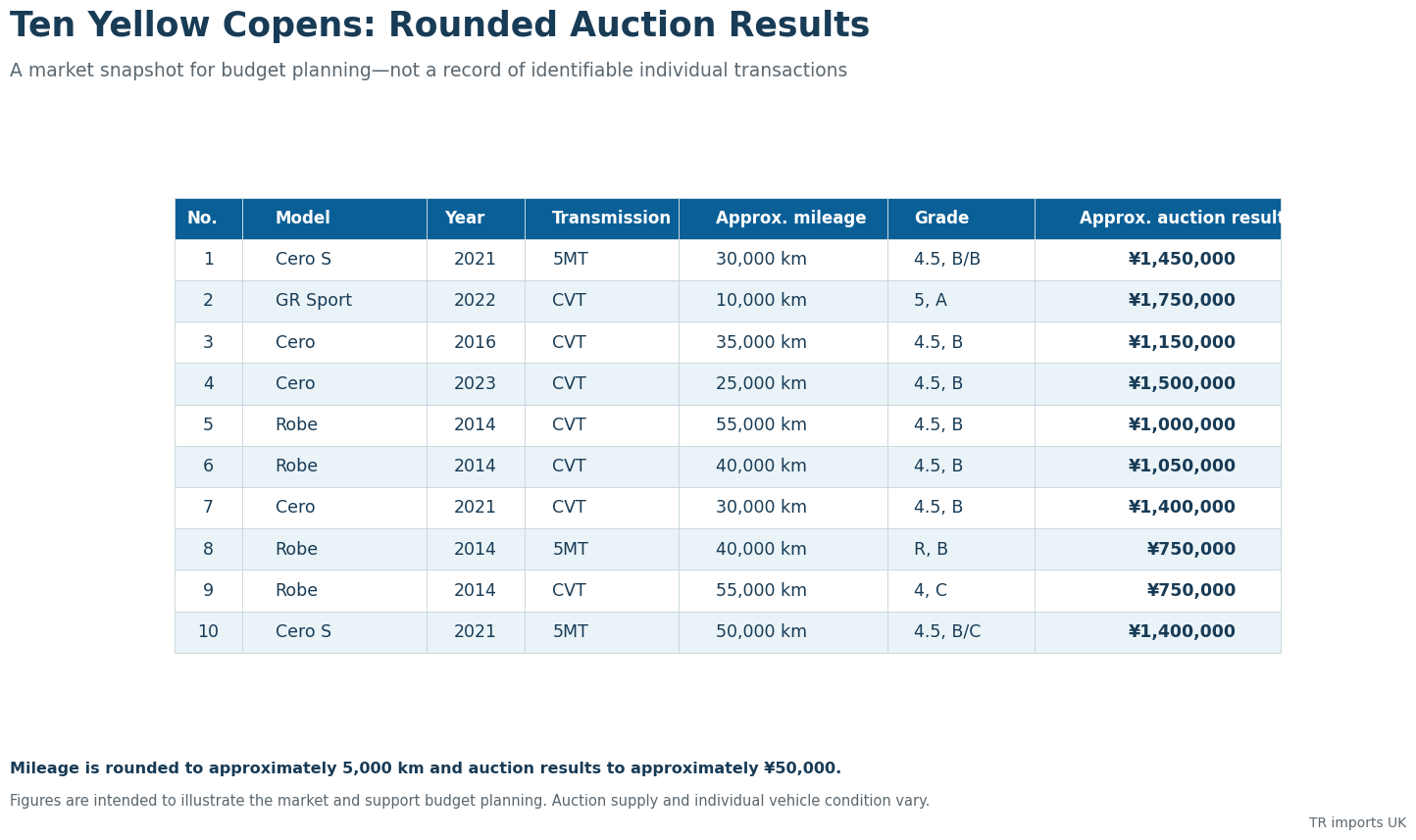
Even before shipping a car to Britain, this small sample spans more than ¥1 million. That range is not random. Model, age, mileage, transmission, condition, repair history, equipment and demand all influence the result.
The cheapest number is therefore not automatically the best use of a customer’s budget.
Add ¥100,000 Before Comparing Anything
The hammer price is not the amount paid to place the car in Japan ready for its next movement.
As a working guide, the costs around an auction purchase can include:
approximately ¥20,000 in auction fees;
approximately ¥9,000 in recycling charges; and
approximately ¥30,000–¥60,000 for transport within Japan, depending on distance.
That produces a typical range of approximately ¥60,000–¥90,000 before consumption tax. For the comparisons in this article, we have rounded this to a fixed ¥100,000 per vehicle. It is an analytical allowance, not a quotation for a particular purchase.
This gives us a more useful starting figure:
Auction starting cost = hammer price + ¥100,000
It still does not include international shipping, UK duties and taxes, registration, exchange-rate movement or work required after arrival. Our article on GBP/JPY exchange-rate risk explains why a sterling budget can change even when the price of the Japanese car does not.
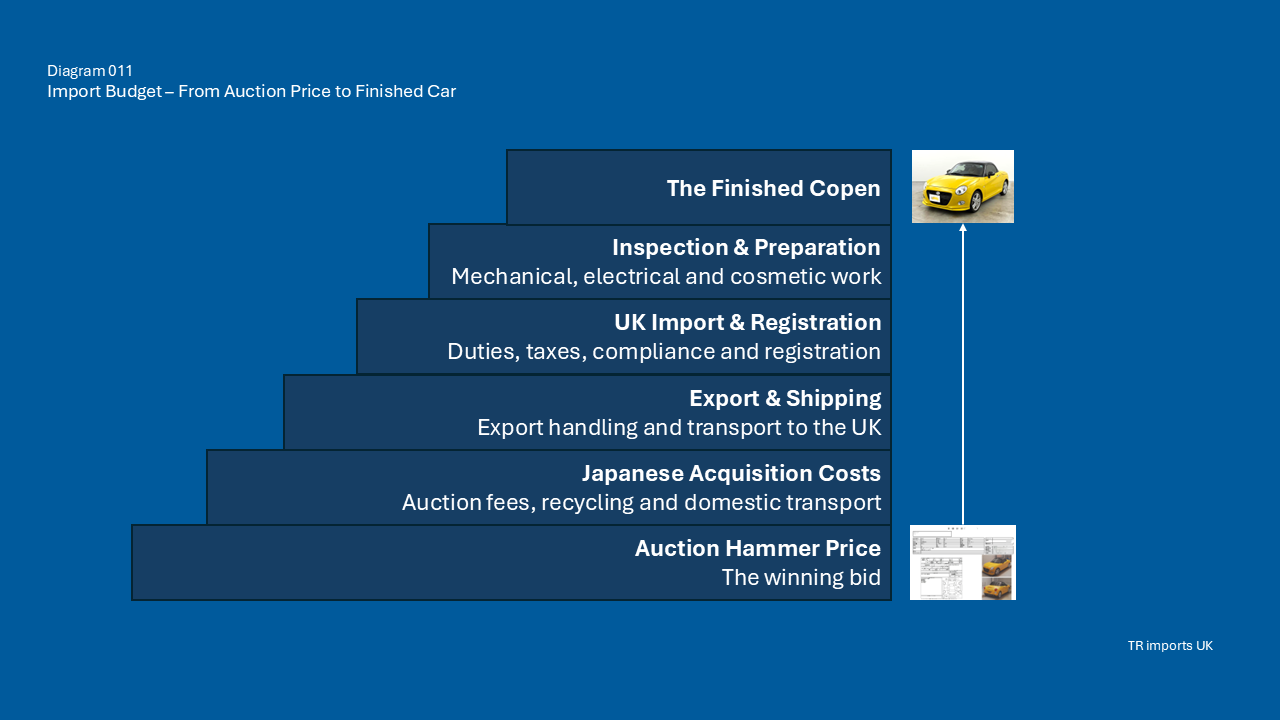
The auction result is only the first stage of of the total budget required to import and prepare a Copen for its intended owner.
Auction Price and Retail Price Are Different Stages
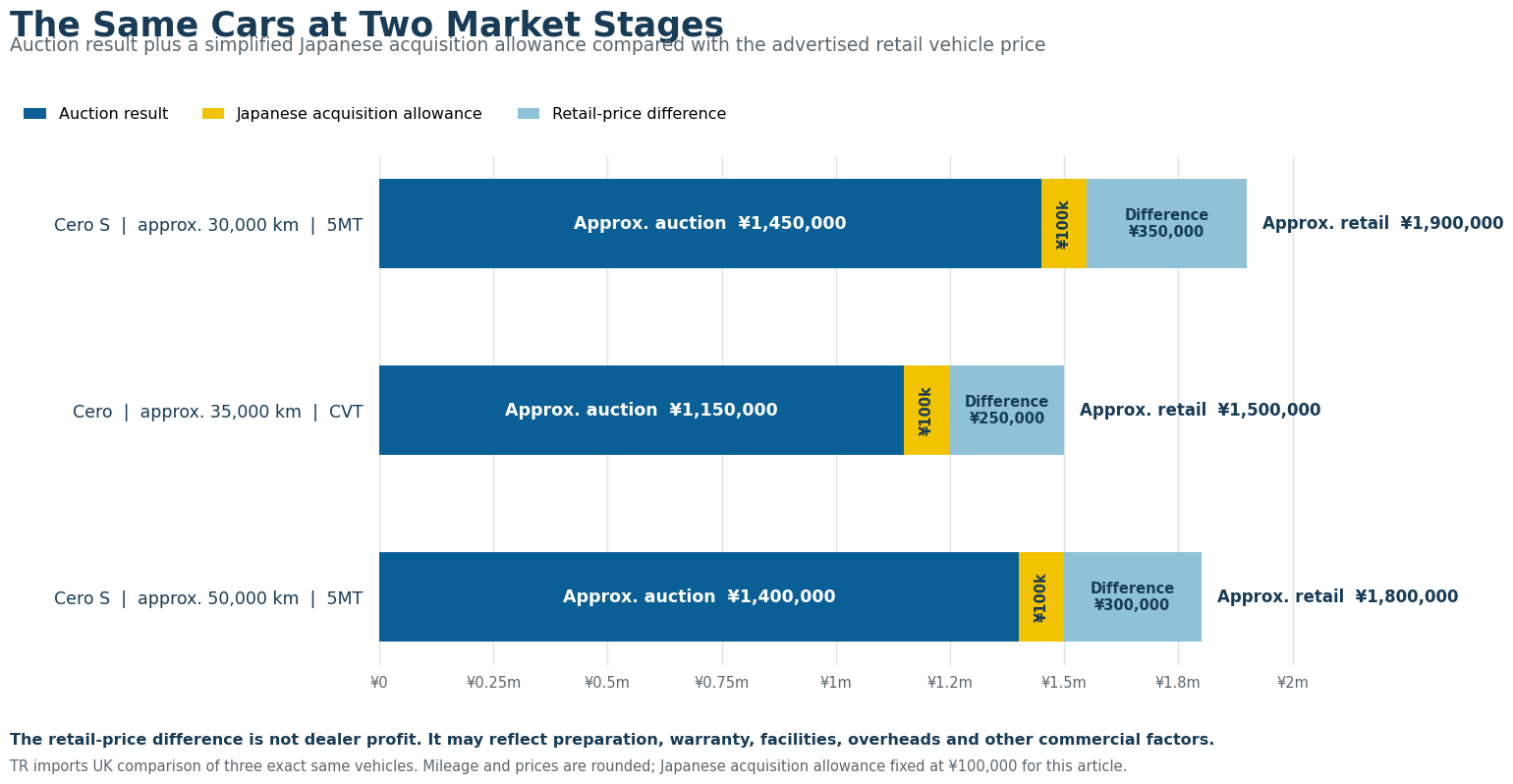
Three of our auction examples subsequently appeared in Japanese retail advertising as the same individual vehicles. Matching the model, year, mileage and chassis details allowed us to compare the same car at two different stages of its journey.
This is the comparison many buyers want to see—but it must be read correctly.
The difference is not automatically dealer profit, and it should not be dismissed as an arbitrary mark-up. After acquiring the vehicle, the selling dealer may transport it, inspect it, service it, repair defects, replace consumable items, clean and refinish it, photograph and advertise it, prepare its documentation and provide a warranty.
That process turns an acquired vehicle into retail stock. We call it retail preparation.
The quantity and quality of that work are not uniform. One dealer may carry out extensive mechanical and cosmetic preparation; another may do considerably less. Warranty terms, facilities, overheads and the standard at which the dealer is willing to present the vehicle also vary.
Consequently, the gap between an auction result and a retail price tells us that another commercial stage has taken place. It does not, by itself, tell us how thoroughly the car has been prepared.
This is why we build an understanding of the individual vehicle before importing it, rather than treating the auction price as the whole story. We explored that philosophy in Before We Import a Car, We Build Understanding.
What Does the Budget Actually Buy?
The ten results become more useful when we stop asking, “Which car is cheapest?” and begin asking, “What kind of Copen does this budget make possible?”
At the lower end of this sample, the choices include early Robes and an R-grade manual car. Moving further up brings good-grade Ceros and later examples into view. At the top sits a very low-mileage GR Sport.
This does not create a permanent price list. Auction supply changes every week, and two cars that look similar in a small summary can be very different when their sheets, photographs, equipment and histories are examined properly.
It does, however, reveal an important budgeting principle: additional money should buy a reason. It may buy lower mileage, a later year, a manual transmission, a particular model, stronger condition or equipment that would be expensive to add later.
If we cannot identify what the additional budget is buying, we have not yet understood the comparison.
Mileage Can Matter More Than Model Year
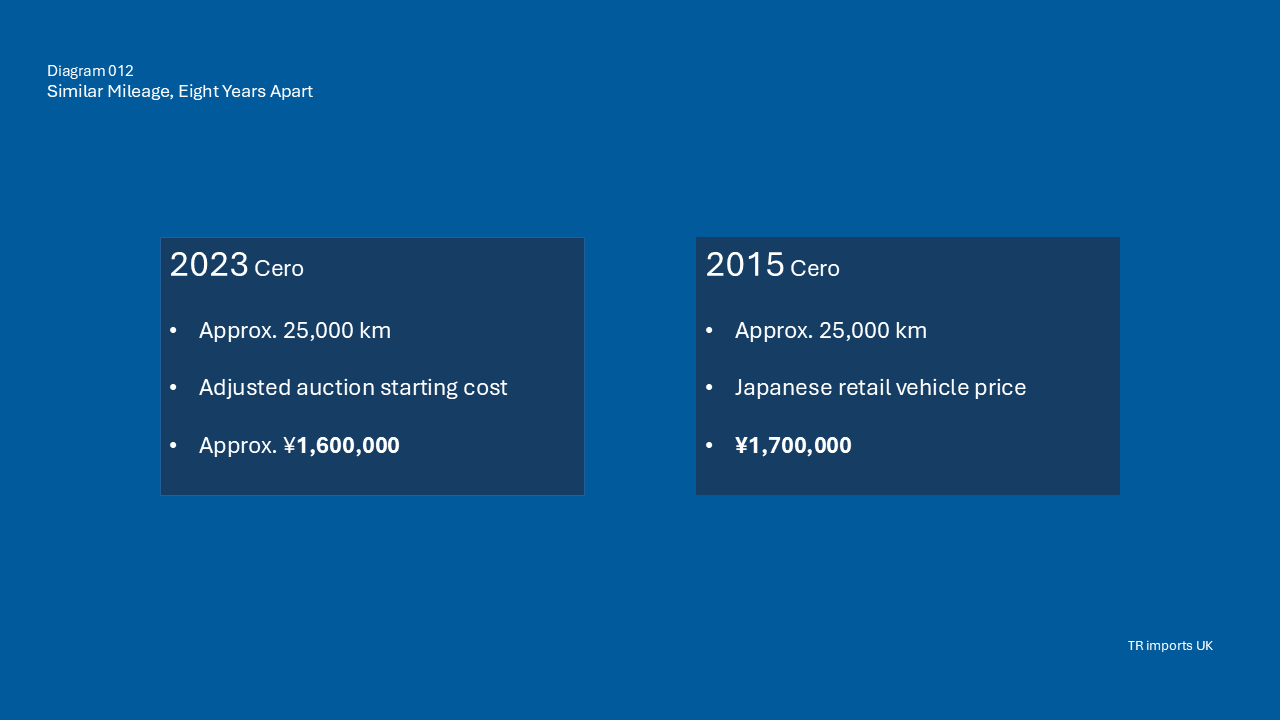
One 2023 Cero in our sample had covered approximately 25,000 km and achieved an auction result of approximately ¥1,500,000. Adding our ¥100,000 allowance creates an adjusted Japanese starting cost of approximately ¥1,600,000.
For comparison, we located a yellow 2015 Cero with similarly low mileage—also approximately 25,000 km—advertised at a Japanese retail vehicle price of approximately ¥1,700,000.
The older retail example was therefore advertised approximately ¥100,000 above the newer auction car’s adjusted starting figure.
This does not prove that age is irrelevant, nor does it make the two cars identical. Equipment, condition, preparation and warranty still matter. It does show why model year alone is a weak way to plan a Copen budget. The Japanese retail market can place substantial value on mileage, and a low-mileage older car may command more than a buyer expects.
The correct question is not simply, “How new can I afford?” It may be, “Which combination of age, mileage and condition gives me the best starting point?”
Does a Toyota Badge Make the GR Sport More Expensive?
It would be easy to assume that a Toyota-badged Copen GR Sport must attract a larger premium than the Daihatsu version.
Our current comparison did not support that assumption.
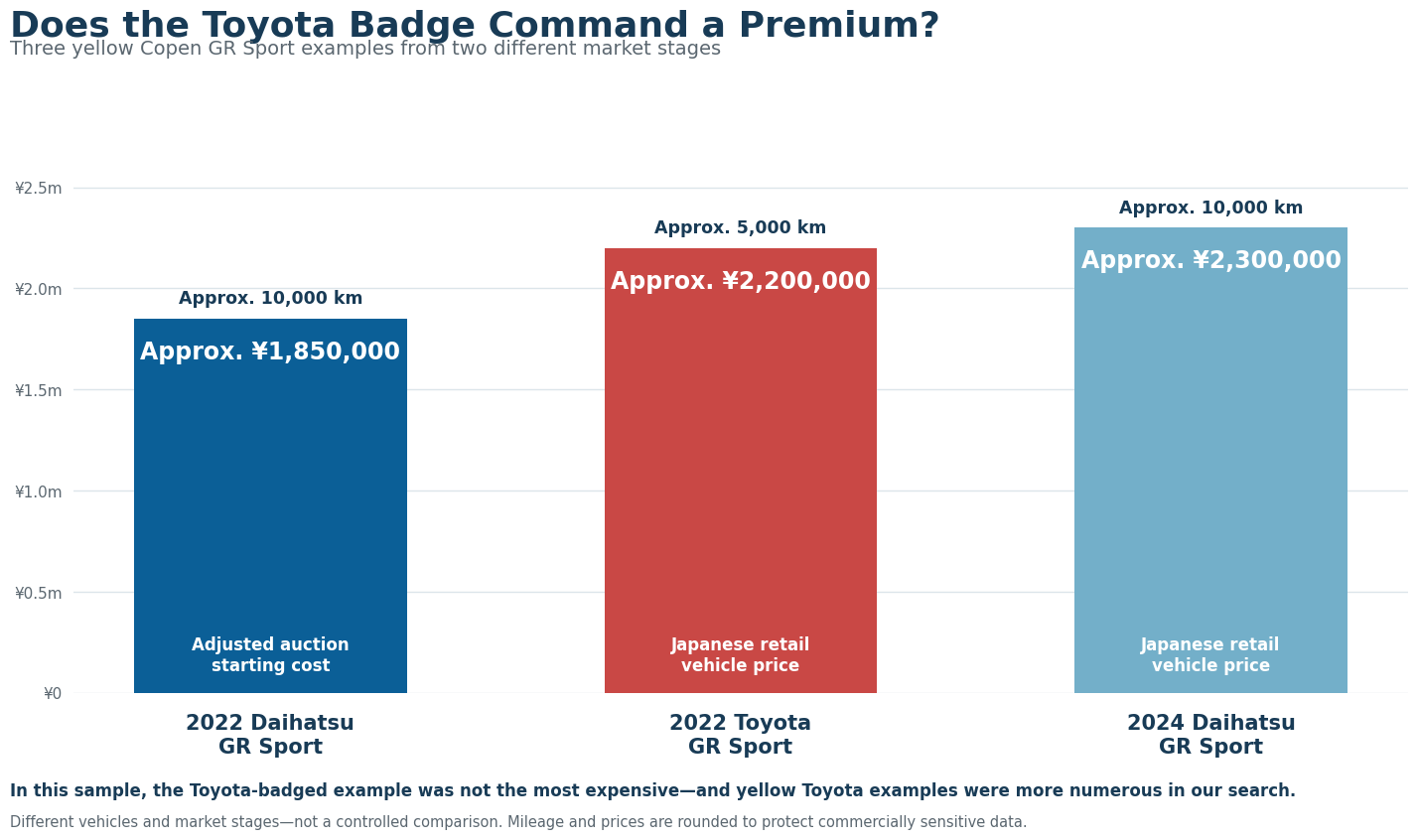
One 2022 Daihatsu GR Sport CVT in our sample had covered approximately 10,000 km. It achieved an auction result of approximately ¥1,750,000, producing an adjusted Japanese starting figure of approximately ¥1,850,000.
A comparable 2022 Toyota GR Sport CVT with approximately 5,000 km was advertised at approximately ¥2,200,000 before on-road costs. We also found a newer 2024 Daihatsu example with approximately 10,000 km advertised at approximately ¥2,300,000.
The newer Daihatsu was more expensive, and our search returned more yellow Toyota GR Sport examples than Daihatsu examples. The badge alone therefore did not provide a reliable shortcut to either price or rarity.
For a customer who simply wants the best individual GR Sport, this is good news. We can search both Daihatsu and Toyota examples and concentrate the budget on condition, mileage, equipment and preparation rather than the badge alone.
It may be even better news for a GR collector or enthusiast. If owning a Copen registered as a Toyota forms part of its appeal, the current availability suggests that it may be possible to pursue that preference without automatically accepting a higher price. In that case, searching specifically for the Toyota version may be worthwhile.
For a deeper explanation of what distinguishes this model beyond the badge, see Why This Copen GR Sport Is More Than Just the Top Model.
The Robe Establishes a Useful Baseline
The three CVT Robes are less dramatic, but they provide a valuable reference point.
Our 2014 auction examples with approximately 40,000–55,000 km produced rounded results from approximately ¥750,000 to ¥1,050,000. Comparable Japanese retail cars with approximately 40,000–55,000 km were advertised from approximately ¥1,200,000 to ¥1,350,000.
This is not evidence of one fixed margin. One auction result was negotiated after the car initially failed to sell, while condition grades, equipment, dealer preparation and warranties differed.
Instead, the Robes show why a customer with a fixed budget should not dismiss the early model. Choosing the right Robe may leave funds available for preventative maintenance, cosmetic improvement or carefully selected upgrades, rather than spending the entire vehicle budget on a later badge or body style.
Our LA400 Copen buyer’s guide provides further context for choosing between the models.
An R-Grade Car Can Be a Deliberate Project Choice
One example in our sample was a 2014 Robe with a five-speed manual gearbox and an R grade. Its rounded auction result was approximately ¥750,000, or approximately ¥850,000 after our Japanese cost allowance.
In Japan, repair history has a specific industry definition. Under the recognised Automobile Fair Competition Code, it refers to a vehicle whose structural components—such as the frame, crossmembers, pillars, floor or roof panels—have been repaired or replaced. It does not simply mean that a bumper or an exterior panel has received cosmetic repair. Auction grading systems vary, but an R grade generally signals that this type of previous structural repair requires investigation.
We also found a broadly comparable 2014 manual Robe without recorded repair history advertised in Japan for approximately ¥1,500,000. This is not a controlled test of how much an R grade reduces a car’s value. The two vehicles were not identical, and no universal percentage can be applied to repaired cars.
There is, however, a different question worth asking.
If an appropriately assessed R-grade car allowed a capable owner to save around ¥400,000 on a DIY project, could that money be used more effectively on tyres, brakes, suspension or other performance parts?
For most customers seeking a finished road car, the answer may still be no. For the right person, with the right project and a clear understanding of the previous repairs, it can be a rational way to allocate the budget.
The objective is not to buy an R-grade car because it is cheap. It is to buy the correct starting point for a project whose finished form has already been considered.
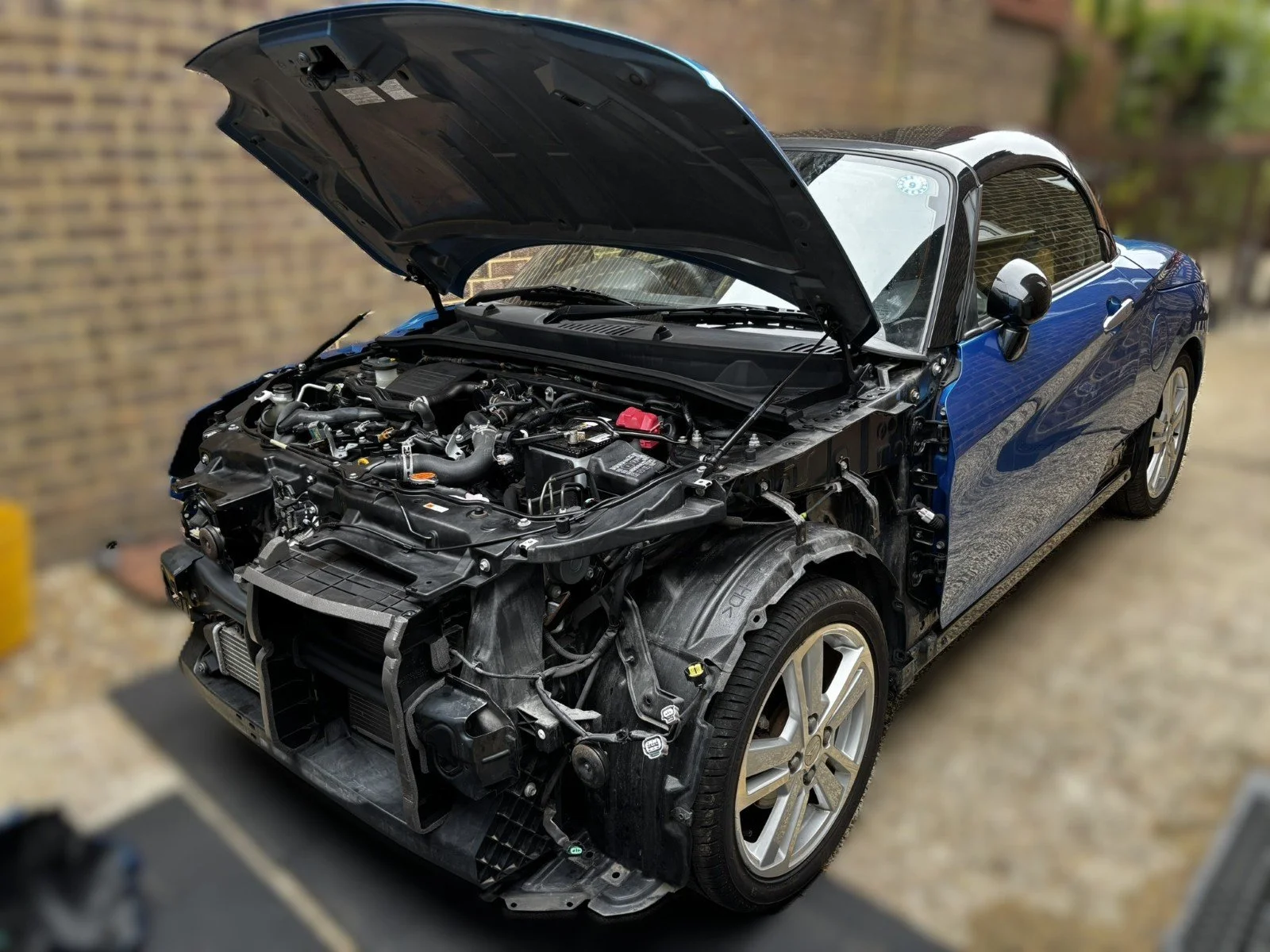
Our Copen Cero demonstrator was not an R-grade car. We deliberately bought it below the usual market price because we knew it had significant problems and intended to use it as a development project. The lower purchase price was the starting point—not the finished cost.
Buying at Auction May Mean Taking On the Preparation Yourself
An auction car can be excellent, and careful assessment of its auction sheet and photographs can reduce risk. Nevertheless, the relatively low purchase price may have a rational explanation: some of the work that separates a wholesale vehicle from a prepared retail car has not yet been carried out.
Buying at auction can therefore mean accepting responsibility for that preparation yourself.
After the car arrives, it may need mechanical inspection, servicing, consumable parts, electrical corrections, cosmetic repairs, corrosion treatment or work arising from earlier repairs. Some cars will need very little. Others may expose needs that were difficult or impossible to confirm from the auction information alone.
This is where a budget based only on the hammer price becomes uncomfortable. The buyer feels that the car has exceeded its budget, when the original budget never included completing the car.
The auction price may be lower—but are you prepared to take responsibility for what happens after the hammer falls?
The purpose of this warning is not to discourage auction buying. Auctions remain an essential and valuable source of Japanese vehicles. It is to make sure that the customer arrives with the right expectations and reserves enough budget for the car after it arrives.
What Retail Preparation Means at TR imports UK
At TR imports UK, retail preparation does not mean washing an imported car, hiding its defects and preparing it for photographs. It means assessing what that individual car requires before we can confidently present it to its next owner.
Every imported car arrives with a different history. One may need mechanical attention. Another may require corrosion prevention. A third may need previous cosmetic or electrical work correcting properly.
We therefore do not treat preparation as one fixed package applied mechanically to every car. We assess the individual vehicle, decide what it needs and carry out the work required to bring it to the standard at which we are prepared to offer it for sale.
On our own Copens, that work has included investigating areas hidden behind exterior panels, correcting unsuitable electrical work, repairing damaged body components and refinishing parts rather than disguising their condition for an advertisement.
This work forms part of the retail price. It is not an arbitrary amount added to an auction result. It reflects the time, parts, facilities, judgement and responsibility required to turn an acquired vehicle into a retail car.
The same principle applies when we help a customer import a car. We do not want the conversation to stop at, “How cheaply can we win one?” We first need to understand what the finished car is expected to be.


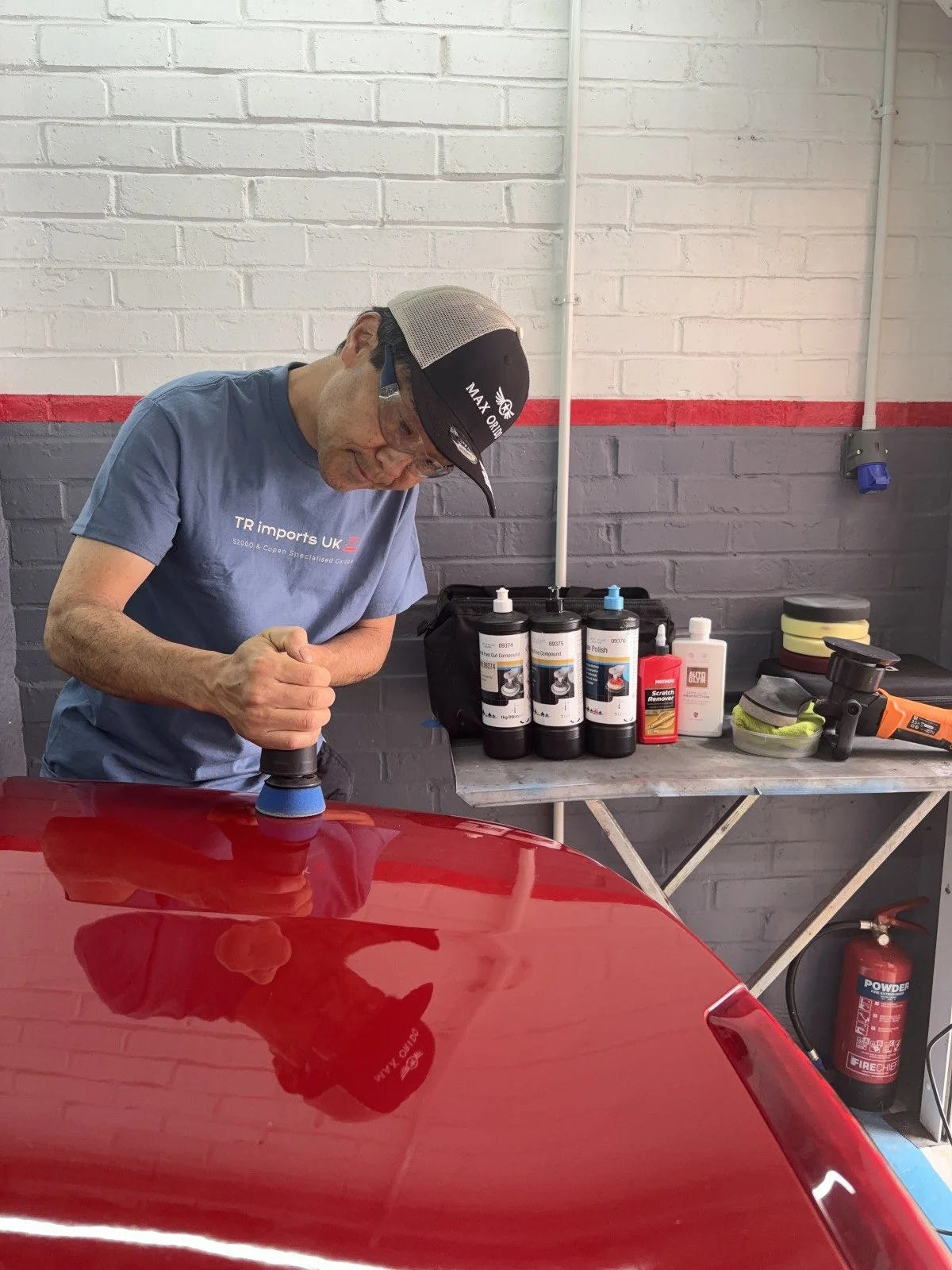
Retail preparation at TR imports UK extends beyond the visible finish. This Toyota Copen GR Sport was inspected behind removable body panels, around its suspension and cooling system, and across its underbody before the final paint correction was carried out.
Auction Car, Japanese Retail Car—or a Planned Import?
The apparent choice is between a cheaper auction car and a more expensive Japanese retail car. In reality, there are three possible starting points:
Buy at auction and accept the cost and responsibility of completing the car.
Buy Japanese retail stock after investigating what preparation and warranty are included in its price.
Define the finished car first, then plan the purchase and preparation budget together before buying.
The third approach is where our import experience and workshop experience meet.
A customer seeking an original, low-mileage keeper should not necessarily pursue the same car as someone planning a modified weekend project. A buyer who wants immediate confidence after registration may allocate the budget differently from an experienced owner who intends to carry out part of the work personally.
Before we bid, we want to know what you ultimately want to own—not merely which auction listing has attracted your attention that week.
We do not begin with the cheapest Copen we can find. We begin with the Copen the customer wants to finish with, then work backwards to decide where the budget should be spent.
So, How Much Should You Budget?
The ten auction results show that the price of the Japanese vehicle alone can vary by more than ¥1 million. Our rounded same-car comparisons show a further retail-price difference of approximately ¥250,000–¥350,000 after applying the simplified Japanese auction-cost allowance used in this article.
Beyond that come export, shipping, UK charges, registration and the individual car’s preparation requirements.
There is therefore no responsible single answer based only on the words “yellow Copen.”
The budget depends on which Copen you want, how much preparation it requires and what standard you expect when the process is complete.
The real question is not whether an auction car or a retail car is cheaper.
It is which starting point allows us to complete the right Copen within your total budget.
If you are considering importing an LA400 Copen, speak to TR imports UK before choosing the vehicle. Tell us whether you want an original keeper, a ready-to-use road car or the basis of a project.
The right conversation should take place before the bidding starts—not after the car has already been bought.