
How Much Exchange-Rate Risk Can You Afford When Importing from Japan?
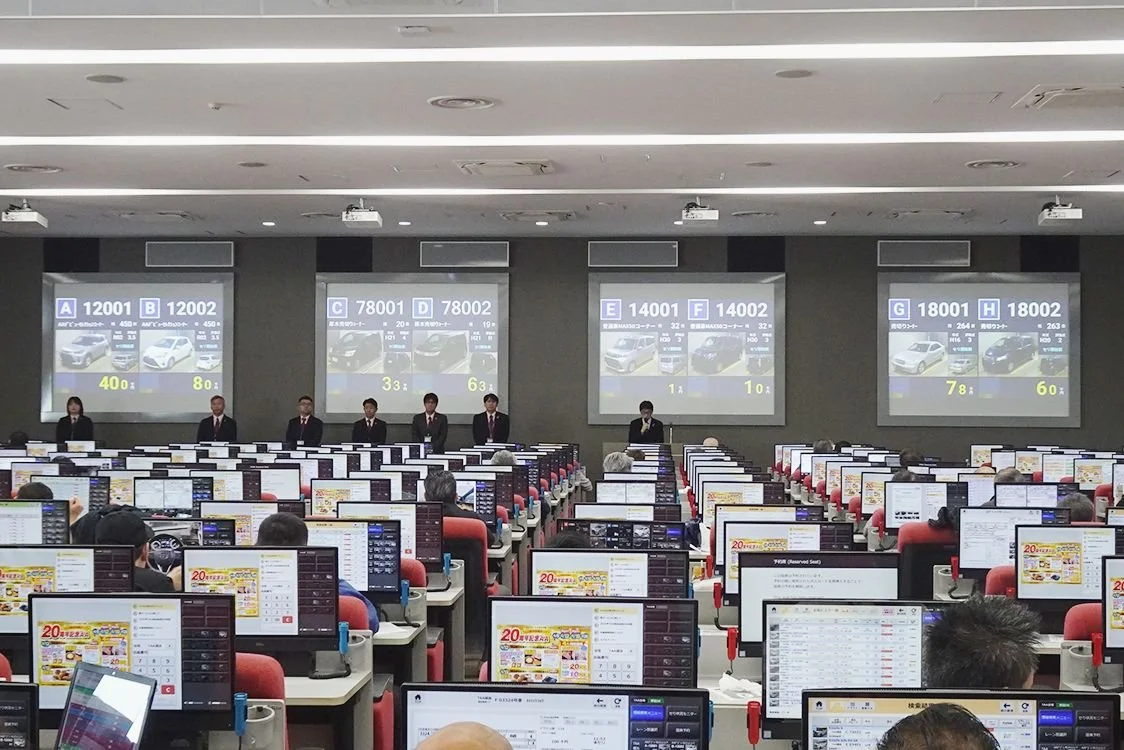
How Much Exchange-Rate Risk Can You Afford When Importing from Japan?
The GBP/JPY exchange rate moved sharply during the second half of last week.
The rate fell from ¥218.5 to ¥212.4 in two trading days. On Monday, it fell below ¥210 for a short time. This was a fall of nearly ¥9 within a few trading days.
If you are buying a car or parts from Japan, this movement affects you directly. When the value of the pound falls against the yen, you need more pounds to buy the same item in Japan.
This article will not try to predict the next exchange-rate movement.
Instead, we will calculate how a change in the exchange rate could affect your budget. You can then decide how much additional cost you are willing to accept.
A note on timing: This article was written on Monday. At that time, the market had not shown a clear direction after the recent fall. The rate may be very different when this article is published at 6 pm on Wednesday. We use ¥210 as the starting point for our calculations. It is not a prediction of the rate at the time of publication.
(Figures are approximate.)
The value of £1 changes over time
The value of £1 in Japanese yen is not fixed. It changes over time.
During the past 30 years, £1 has been worth as much as ¥250 and as little as ¥120. The starting rate used in this article is ¥210.
Let us look at three charts. We will start with the period following the COVID-19 pandemic. We will then extend the view back to the Brexit referendum and finally look back over 30 years.
The charts will allow us to see the movements clearly.
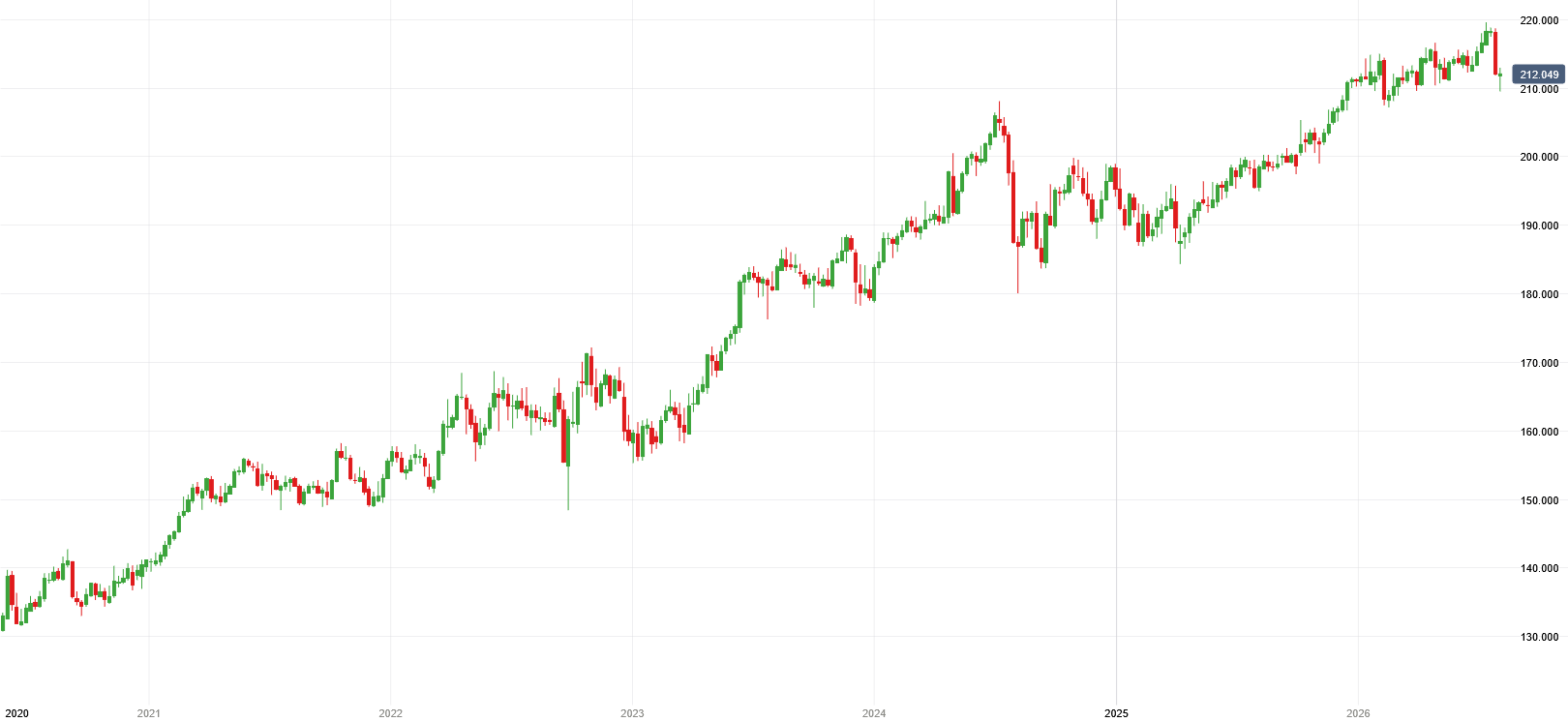
Since 2020: the COVID-19 pandemic and a gradual rise
From 2020, GBP/JPY followed a general upward trend.
The rise was not continuous, but £1 gradually bought more yen. The rate moved from around ¥150 towards ¥220.
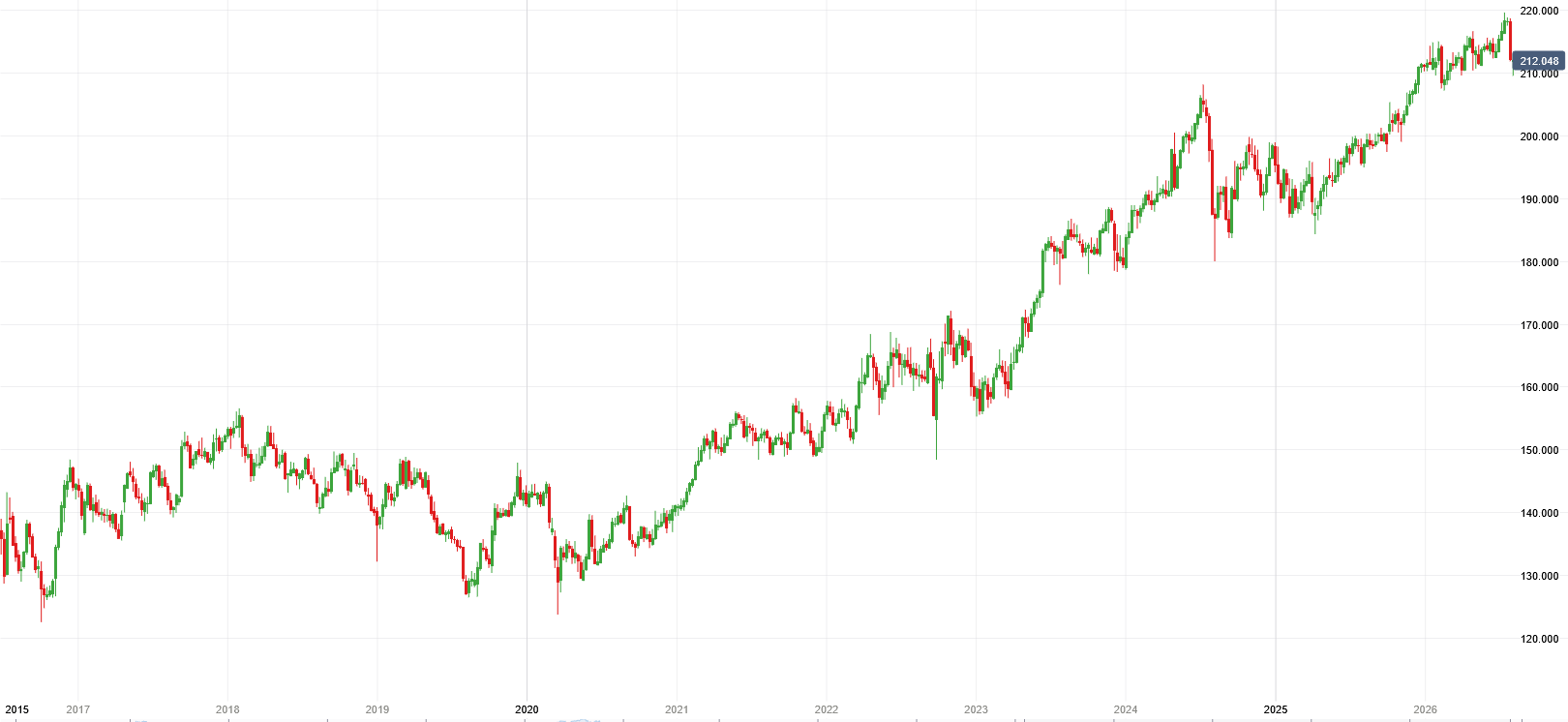
Since 2016: the Brexit referendum, a sideways period and a rise
GBP/JPY fell sharply around the Brexit referendum in 2016.
It then moved sideways for several years. From 2020, the gradual rise shown in the first chart began.
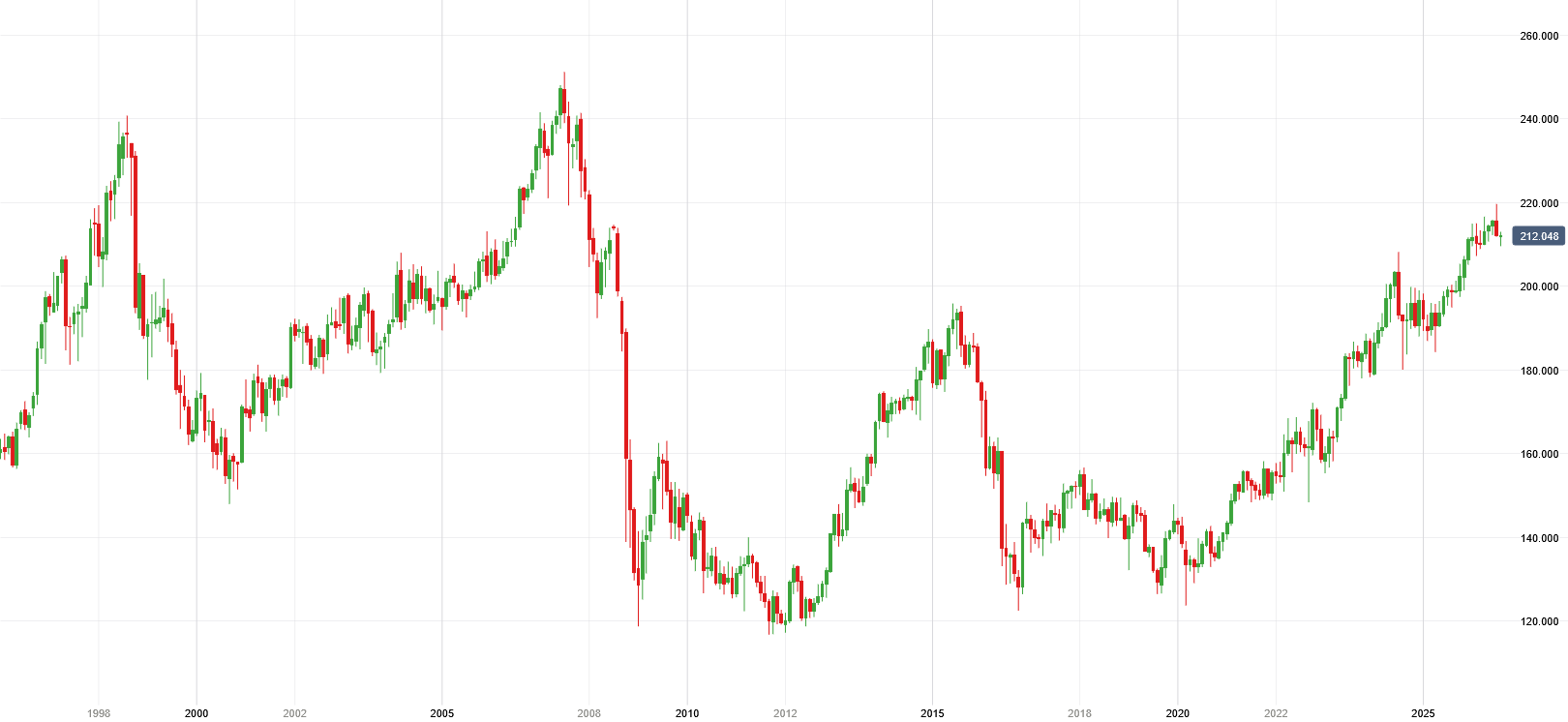
Since 1996: the Global Financial Crisis and the Swiss franc shock
The 30-year chart shows sudden falls during major events, including the Global Financial Crisis and the Swiss franc shock.
It also shows long periods when GBP/JPY moved sideways.
The three charts show an interesting fact:
The falls appear to happen quickly. The rises appear to develop more slowly.
We have now seen three important figures:
The highest point: ¥250
The lowest point: ¥120
Our current starting point: ¥210
We also need a middle reference point for our calculations.
The simple midpoint between ¥250 and ¥120 is ¥185. However, the charts show that GBP/JPY spent long periods in the ¥160–¥170 area.
For this article, we will therefore use ¥165 as a convenient middle reference point.
We can now calculate how much more money you would need if the exchange rate moved.
(Figures are approximate.)
How much would your budget increase?
We will start with an exchange rate of:
£1 = ¥210
The table below shows how much additional money you would need if the rate fell to ¥200, ¥190, ¥165 or ¥120.
| Purchase price in Japan | At ¥200 | At ¥190 | At ¥165 | At ¥120 |
|---|---|---|---|---|
| ¥10,000 | +£2 | +£5 | +£13 | +£36 |
| ¥200,000 | +£48 | +£100 | +£260 | +£714 |
| ¥500,000 | +£119 | +£251 | +£649 | +£1,786 |
| ¥1,500,000 | +£357 | +£752 | +£1,948 | +£5,357 |
| ¥4,000,000 | +£952 | +£2,005 | +£5,195 | +£14,286 |
A ¥10,000 purchase could be a small part.
A ¥200,000 or ¥500,000 purchase could be a larger part or a group of parts.
A ¥1,500,000 purchase could be a lower-priced vehicle or project.
A ¥4,000,000 purchase could be a full vehicle import.
The table compares only the purchase price in yen. It does not include shipping, import duty, VAT, transfer charges, exchange fees or other import costs.
Let us look at the ¥1,500,000 example.
At ¥210, you would need:
¥1,500,000 ÷ ¥210 = £7,143
At ¥200, you would need:
¥1,500,000 ÷ ¥200 = £7,500
The Japanese price has not changed. It is still ¥1,500,000.
However, you now need an additional £357 because the exchange rate has changed.
If the rate falls to ¥190, you need £7,895. This is £752 more than you needed at ¥210.
The same calculation becomes more important when the purchase price is higher.
For a ¥4,000,000 purchase, a change from ¥210 to ¥200 increases the required budget by £952. At ¥190, the increase is £2,005.
This is how an exchange-rate movement becomes an actual cost to the buyer.
(Figures are approximate.)
The exchange rate is only one part of the overall import budget. Before comparing vehicle prices, it is also important to understand what is—and is not—included in the finished project.
How does this affect a JDM import deposit?
The same calculation applies when a customer begins a JDM Bespoke Import project.
First, the customer gives us a maximum auction bid. The auction house may also charge other costs.
Together, these figures form the required yen budget:
Maximum auction bid instructed by the customer
+ other auction-house charges
= required budget in yen
We then use the exchange rate on the contract date to calculate the deposit in pounds:
Required yen budget
÷ exchange rate on the contract date
= deposit in pounds
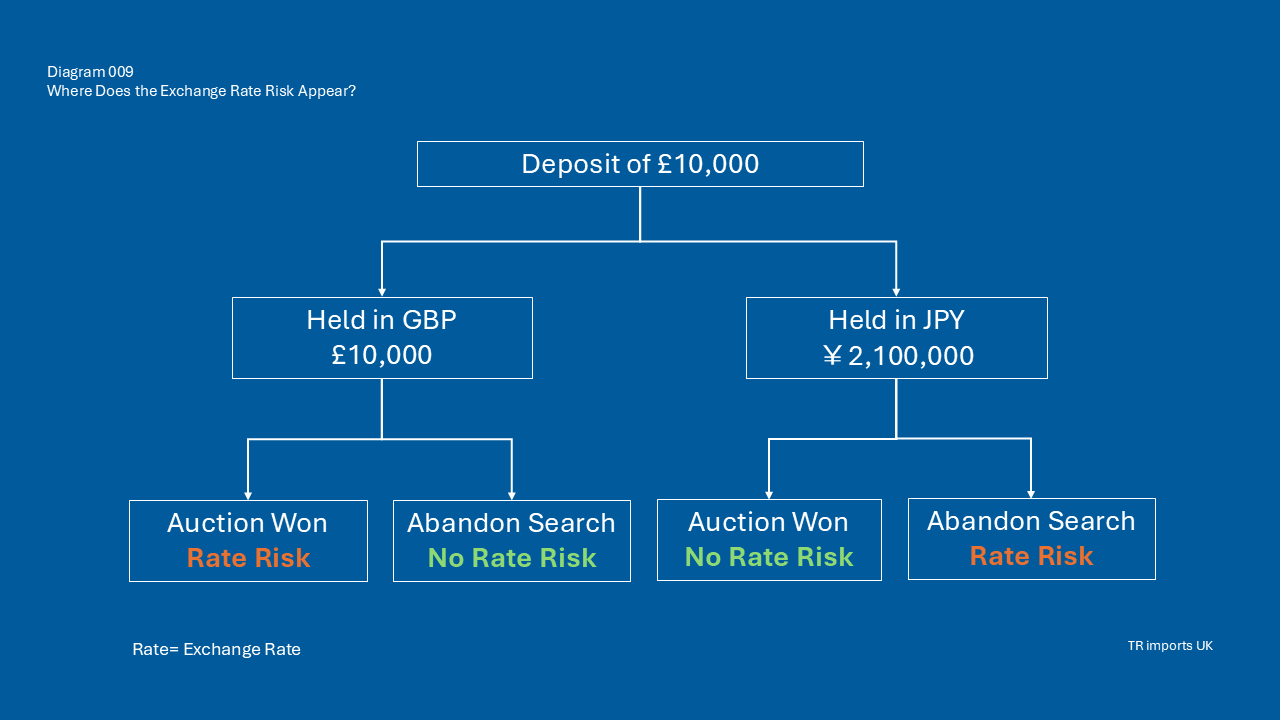
Let us use a deposit of £10,000 and a contract rate of £1 = ¥210.
This gives the customer a yen budget of:
£10,000 × ¥210 = ¥2,100,000
The customer can give one of two instructions:
Keep the deposit in pounds until a car is purchased.
Convert the deposit into yen at the start of the project.
Neither choice removes all exchange-rate risk. The risk appears at a different time.
Option 1: keep the deposit in pounds
If the search is stopped before a car is purchased, the £10,000 can be returned as £10,000. There is no exchange-rate gain or loss on the deposit.
If a car is purchased, however, the cost of buying ¥2,100,000 will depend on the exchange rate at that time.
For example, if the rate falls from ¥210 to ¥190:
¥2,100,000 ÷ ¥190 = £11,053
The customer would need to add £1,053 to the original £10,000 deposit.
If the rate rises to ¥250:
¥2,100,000 ÷ ¥250 = £8,400
Only £8,400 would be needed to buy the same ¥2,100,000.
Option 2: convert the deposit into yen
If the £10,000 is converted at ¥210, the project holds ¥2,100,000.
If a car is purchased within this budget, the customer already has the required yen. A later exchange-rate movement does not change this auction budget.
However, the position changes if the customer stops the search.
The ¥2,100,000 must then be converted back into pounds. Its value will depend on the exchange rate at that time.
The table below shows the value of ¥2,100,000 at several exchange rates.
| Exchange rate when converting back | Value of ¥2,100,000 | Difference from £10,000 |
|---|---|---|
| ¥250 | £8,400 | −£1,600 |
| ¥220 | £9,545 | −£455 |
| ¥200 | £10,500 | +£500 |
| ¥190 | £11,053 | +£1,053 |
| ¥165 | £12,727 | +£2,727 |
| ¥120 | £17,500 | +£7,500 |
We can now compare the four possible situations.
| Deposit instruction | A car is purchased | The search is stopped |
|---|---|---|
| Keep the money in pounds | The cost in pounds changes with the exchange rate | The original £10,000 can be returned |
| Convert the money into yen | The ¥2,100,000 auction budget is already available | The refund in pounds changes with the exchange rate |
If the deposit stays in pounds, the customer faces exchange-rate risk when a car is purchased.
If the deposit is converted into yen, the customer faces exchange-rate risk when the search is stopped and the money is converted back into pounds.
The exchange-rate risk has not disappeared. It has moved from one possible result to another.
These examples repeat the calculation from the previous section deliberately. The price in yen can remain the same while the amount in pounds changes.
Real transactions will also include exchange margins, transfer fees and a difference between buying and selling rates. These have not been included in the examples.
(Figures are approximate.)
Important information about financial responsibility
This article provides general information about the effect of exchange-rate movements on purchases from Japan.
It is not financial, investment or foreign-exchange advice.
Customers must obtain their own market information. They must also make their own decisions about exchange-rate risk.
TR Imports UK can explain the available deposit options. We can then follow the instruction chosen by the customer.
We do not predict future exchange rates. We also do not tell customers whether to keep a deposit in pounds or convert it into yen.
The customer is responsible for this decision.
How much additional cost can you accept?
Let us return to the ¥1,500,000 purchase.
At ¥210, it costs £7,143.
At ¥200, it costs £7,500.
The difference is £357.
Is £357 a large increase?
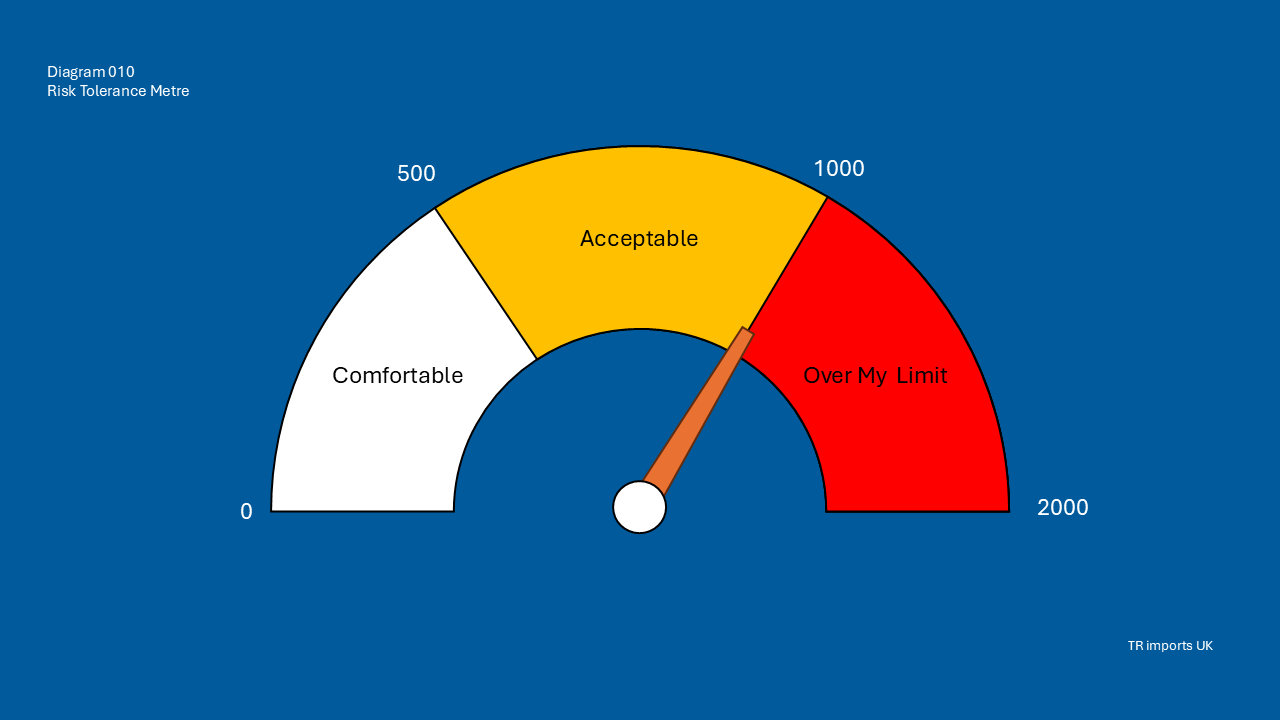
The answer will be different for each person.
One buyer may decide that £357 is too much. Another buyer may not be concerned by it.
But the exchange rate may continue moving.
A buyer who accepts an increase of £357 may feel differently when the increase reaches £752 at an exchange rate of ¥190.
This is your personal limit, or risk appetite.
Having a limit is normal. It does not mean that you are not suitable for JDM ownership.
It means that you have financial boundaries.
The important point is to express your limit as a number.
For example:
“I can accept an additional cost of £500.”
Or:
“I can accept an increase of up to £1,000. More than that would put too much pressure on my budget.”
Do not increase your budget simply because you want to complete the purchase.
Importing a JDM car costs money. Buying the vehicle is also only the beginning.
You may later need money for servicing, repairs, accident damage, replacement parts and modifications.
If a relatively small exchange-rate movement would use all your available money, it may be too early to begin the project.
You could delay the project. You could choose a less expensive car. You could also decide that importing is not the right choice for you at the moment.
Stopping is also a valid decision.
Turn your limit into a clear instruction
Suppose you have completed the calculations and decided:
“I can accept up to £1,000 of additional cost caused by an exchange-rate movement.”
At an exchange rate of ¥210:
£1,000 × ¥210 = ¥210,000
Your £1,000 limit is equal to ¥210,000 at this exchange rate.
If you choose to convert your deposit into yen at the start of the project, you may decide to increase your maximum auction bid by around ¥200,000.
Your total budget has not increased. You have decided to use part of your accepted exchange-rate allowance as purchasing power instead.
This does not mean that converting the deposit into yen will create a profit or make the car cheaper.
It means that you understand the amount of risk you are willing to accept. You can then decide where to place that money.
You could:
Keep it available for a possible exchange-rate movement.
Add it to your maximum auction bid.
Reserve it for servicing or repairs after the car arrives.
Keep it completely outside the project.
Before doing these calculations, you may simply think:
“I am not worried about the exchange rate.”
After doing the calculations, you can give a clear instruction:
“My limit is £1,000, and this is how I want to use it.”
You now have four clear figures:
Your target vehicle
Your maximum auction bid
The additional exchange-rate cost you can accept
Your instruction for the deposit
At this point, the JDM Bespoke Import project can move from the proposal to the contract.
A proposal does not start the project. Thinking about a vehicle does not reserve it. The auction market and the exchange-rate market will continue moving while you make your decision.
The project starts when the terms are agreed, the contract is signed and the deposit is received.
Before that point, you do not need to predict the market.
You need to understand the figures, know your limit and choose a budget that you can support.
Related reading:
If you are considering an LA400 Copen, our buyer’s guide explains how the auction, deposit and purchasing process works in practice.