
What We Learnt by Replacing Every Drivetrain Mount on Our Honda S2000
Honda S2000 Restoration Journal
Part of our Honda S2000 Restoration & Tuning Series
A Honda S2000 can still look exceptionally well preserved after more than twenty years.
The paint may be regularly polished, the interior carefully maintained, and the car protected from poor weather. Underneath that well-kept appearance, however, many of its original rubber components have spent two decades supporting the engine, transmission and differential.
They may not be visibly broken. The car may not produce an obvious warning noise. Nevertheless, those mounts may no longer control the drivetrain as precisely as they once did.
We discovered this while restoring the demonstration S2000 used at our TR Imports UK workshop.
No obvious symptoms—only visible age


Our S2000 had covered approximately 75,000 miles when we acquired it. After driving it for another 5,000 miles, we decided to replace all the principal drivetrain mounts.
Before the work, there was no obvious vibration, knocking noise or serious delay in the drivetrain response. The car still felt good to drive.
What we could see was age.
The original mounts did not have dramatic external cracks, but the rubber had compressed over time. Fatigue was also visible where the rubber met the metal sections, while corrosion had developed across several of the steel components.
This is one reason old mounts can be overlooked. Their condition normally deteriorates gradually, allowing the driver to become accustomed to the changing behaviour of the car.
A mount does not need to split completely before it begins to affect how the drivetrain moves.
What the mounts actually do
The engine, transmission and differential cannot be mounted completely rigidly to the body. They require controlled movement, while vibration must also be isolated from the cabin.
The mounts provide that balance.
As the rubber ages and compresses, the drivetrain can move further before the load is transferred through the car. That does not necessarily mean the engine produces less power or that the tyres suddenly have less grip.
What can change is the way the car responds.
Excessive movement may make the connection between the throttle, drivetrain and rear wheels feel less immediate. Changes in load can feel less precise, particularly during acceleration, gear changes and the transition between applying and releasing the throttle.
Standard Honda mounts or uprated mounts?

Replacing old mounts does not automatically mean fitting the hardest available components.
For an S2000 used principally on the road, new genuine Honda mounts can be the correct choice. They restore the support and isolation intended by Honda while retaining the refinement expected from a road car.
Our demonstration S2000 has a different role. It is used to develop our workshop knowledge and also takes part in circuit driving, so we wanted to reduce drivetrain movement and create a more direct response.
For that reason, we selected uprated Spoon engine, transmission and differential mounts.
The choice was based on how this particular car would be used—not on the assumption that an uprated component is always better for every owner.
Replacing the mounts one stage at a time


Instead of replacing everything in one operation, we completed the work in stages.
We started with the transmission mounts, followed by the engine mounts and finally the four differential mounting points.
This allowed us to drive and assess the car between each stage. It also revealed something we might not have noticed if every component had been replaced at once.
During the intermediate stages, the car developed an unnatural vibration and rattling noise that had not been present before the work began.
This was not a subtle difference that required a particularly sensitive driver to detect. It was noticeable enough that we believe almost anyone driving the car would have recognised it.
At that stage, new uprated mounts and old, softer mounts were supporting different parts of the same drivetrain. Our experience suggested that this mismatch in stiffness had created an imbalance or resonance.


Once the remaining mounts had been replaced and the drivetrain was supported as a complete system, the vibration and rattling stopped immediately.
That experience demonstrated why the drivetrain should be considered as a whole. Changing the stiffness at one mounting point can affect the behaviour of the other mounting points.
Completing the differential mounting system

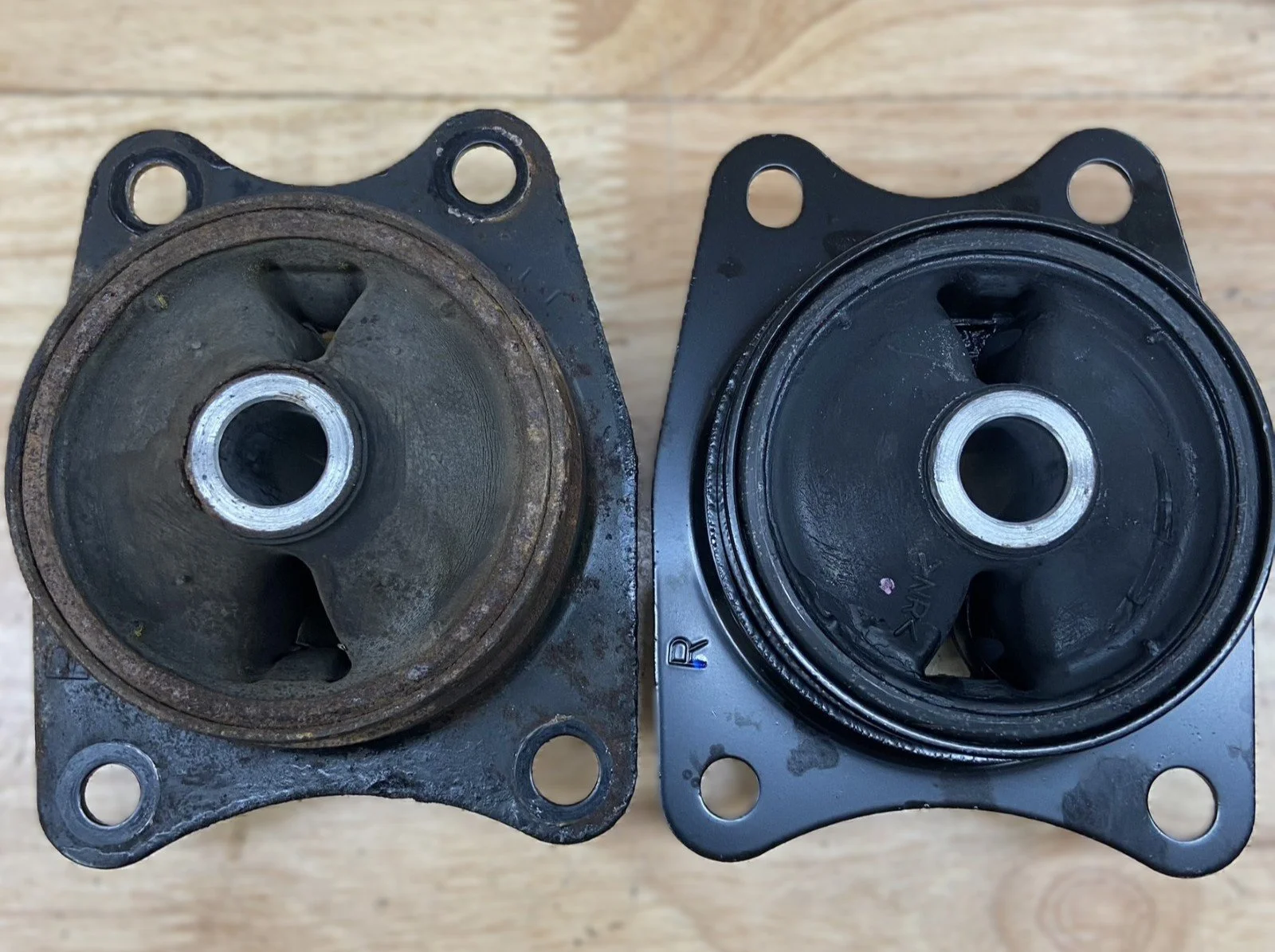
The differential is supported at two front and two rear mounting points.
We replaced all four original mounts with Spoon components. We also fitted CSO Duracon differential mount rings alongside them.
The intention was not simply to make the differential completely rigid.
The CSO rings reduce the available movement around the mount while retaining a controlled transition before the differential reaches the limit of that movement. In principle, this creates a buffer rather than allowing the differential to move freely and then arrive abruptly at the harder limit of the uprated mount.
This combination suited what we wanted from our circuit-driven demonstration car: less unnecessary movement, but with the load applied progressively.


The difference after completing the work
Before replacing the mounts, we had not identified a serious drivability problem.
After completing the entire system, however, the car appeared to respond more immediately. The connection between the throttle and the rear wheels felt clearer, and the traction response felt more consistent as the drivetrain came under load.
It was only after experiencing the completed car that the softness of the previous arrangement became apparent.
This is an important point for long-term owners. When a component deteriorates gradually over many years, there may be no single moment when the car suddenly feels wrong. The owner simply adapts to a series of very small changes.
The work was completed in spring 2023. Since then, the S2000 has covered approximately 12,000 miles, and the improved feeling remains present three years later.
What should an S2000 owner consider?
Mileage alone cannot confirm the condition of a mount. Age, heat, contamination, storage conditions and the way the car has been used can all influence the rate of deterioration.
However, inspection is worthwhile if:
You have recently purchased an S2000 and do not know its maintenance history.
The car still has its original mounts after more than twenty years.
You notice additional movement as the throttle is applied or released.
Gear changes no longer feel as settled as they once did.
New vibrations or rattling noises have appeared.
You are preparing the car for more demanding road or circuit use.
Vibration and noise can have many possible causes, so they should not automatically be blamed on the mounts. The condition of the vehicle should be inspected before parts are selected.
Preserving more than the appearance
Keeping an S2000 original does not mean leaving every ageing component untouched.
Replacing deteriorated rubber parts with genuine Honda components can help return a road car to the behaviour its engineers intended. For owners seeking a more direct response, carefully selected uprated mounts may be appropriate—but the additional vibration, noise and effect on the complete drivetrain must be considered.
At the TR imports UK workshop, this is why we begin with the condition and intended use of the car rather than assuming that the hardest component is the best one.
Our demonstration S2000 allows us to install, test and monitor these changes over time. That experience then informs how we inspect customer cars and discuss the balance between originality, refinement and performance with their owners.
Beautiful paintwork preserves what everyone can see.
Maintaining the components underneath preserves the way an S2000 was meant to feel.
See the Complete S2000 Restoration
Explore the complete restoration and development of our demonstration S2000—and the workshop experience behind it:
This is not only an S2000 issue
Although this case study focuses on our S2000, the same ageing process affects the mounts used in many other Japanese cars.
We have already sourced all three genuine powertrain mounts for our demonstration Daihatsu Copen Cero. Unlike our circuit-driven S2000, the objective with the Copen is not to increase stiffness. It is to preserve its road-going refinement and restore the controlled behaviour originally designed into the car.
Once the work is completed, we will compare the old and new components and document the results through the TR Imports UK workshop.
Different cars require different solutions, but the principle remains the same: preserve not only how the car looks, but how it was designed to feel.
