
Understanding starter-motor noise—and choosing between an overhaul, a reconditioned unit and a new replacement
Part of our Honda S2000 Restoration & Tuning Journal Series
Last week, we discussed your S2000’s ignition coils and spark plugs.
This time, we move one step earlier: the starter motor that gets the engine turning.
Does your S2000 make a brief, high-pitched whine immediately after the engine fires?
I do not mean the normal sound of the starter cranking the engine. I mean the extra “wheee” that follows, just as the engine begins running by itself.
If you hear it every time, you may have come to regard it as part of the car’s character.
But a familiar noise is not necessarily a healthy noise.
Today, let us look at what the starter should do, what can cause that extra sound, and how you might plan the repair.
1. What Does the Starter Actually Turn?
A stationary engine needs an external source of power to begin turning.
The starter supplies that initial rotation using electricity from the battery.
On the S2000, it sits beneath the intake manifold, close to the joint between the engine and transmission. It is not a component you normally notice when looking into the engine bay.
At its nose is a small pinion gear.
During starting, this engages with the ring gear around the flywheel. The starter turns the flywheel and, through it, the crankshaft. Fuel delivery and ignition then allow the engine to begin running under its own power.
In the photograph below, you can see the ring-gear teeth through the opening left by the removed starter.
This is where a relatively small electric motor gets the engine moving.
With the intake manifold removed, the starter’s position on the side of the S2000’s engine becomes easier to see.
The flywheel ring gear is visible through the starter mounting opening.
2. Once the Engine Starts, the Starter Must Disengage
Engage the gears when needed.
Disengage them once the engine is running.
The starter needs a mechanism to do both, alongside the motor that provides the turning force.
DENSO’s technical manual describes the roles of the magnetic switch, drive mechanism, pinion gear and overrunning clutch.
When you operate the starter, the magnetic switch—often called the solenoid—operates the engagement mechanism and closes the electrical contacts supplying the motor.
The pinion engages the ring gear, and the motor cranks the engine.
Once the engine fires, however, the engine side begins driving the pinion faster than the starter would normally turn it.
The overrunning clutch allows the pinion to freewheel, protecting the motor from being driven at excessive speed. Think of it as a one-way clutch: it transmits the starter’s driving force in one direction while allowing the engine side to overtake it.
When you release the starting control, the electrical contacts open and the mechanism withdraws the pinion from the ring gear.
All of this happens within a very short time.
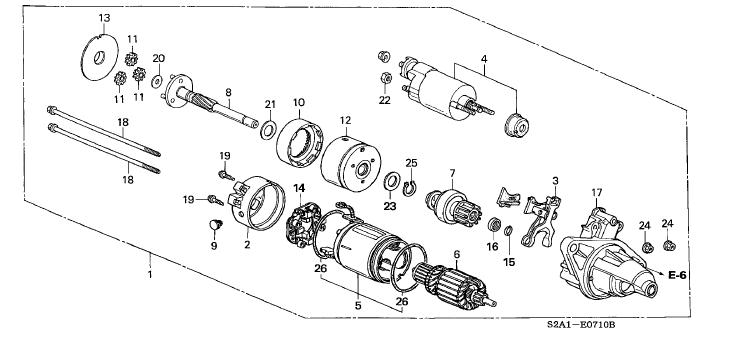
Honda’s starter-motor parts diagram shows the motor, switch and drive components within the assembly.
3. Where Does That Extra Whine Come From?
Trouble begins when disengagement or movement within the starter stops working properly.
For example, if the pinion does not slide back freely, it can remain engaged briefly after the engine has fired.
DENSO lists pinion sliding failure, worn bushes and wear to the pinion or ring-gear teeth among the possible causes of abnormal starter noise.
It also describes faults in the magnetic switch or control circuit that can prevent the starter from stopping.
The important point is that a starter can still crank the engine while developing a problem with the way it disengages afterwards.
Every start involves mechanical movement and a substantial electrical load. Mileage alone does not describe that workload; the number of times the engine has been started matters too.
If you hear that extra sound after starting, have the noise assessed and the starter and its surrounding circuit checked.
The fact that the engine starts does not complete the diagnosis.
The pinion end of the removed starter. The gear must move into engagement and withdraw again, as well as rotate.
4. Overhaul, Reconditioned Unit or New Replacement?
A faulty starter does not automatically mean buying a brand-new assembly.
There are three routes to consider.
The first is to overhaul your existing starter.
It is dismantled and inspected, then the necessary components are renewed. Honda’s parts catalogue identifies assemblies such as the clutch, switch and armature; the inspection determines which parts require attention.
The second route is a reconditioned—or rebuilt—starter supplied as a complete replacement assembly.
This can offer a lower purchase price than a new unit. However, the parts renewed and the testing carried out vary between suppliers, so it is worth understanding what you are buying. Some suppliers also require your old starter to be returned as an exchange unit.
The third route is a new starter assembly, renewing the complete unit rather than selected internal components.
Which makes sense for you depends on your budget and how long you intend to keep the S2000.
Compare the complete job.
An overhaul involves removal, dismantling, inspection, rebuilding and testing. A reconditioned or new assembly involves sourcing the correct replacement and fitting it. Parts availability and turnaround time also belong in that comparison.
The photograph shows the old and new starters side by side.
Their external appearance tells us little about the condition of the components that have spent years working inside.
Old and new starter assemblies. Compare an overhaul, a reconditioned unit and a new replacement with labour and procurement time included.
5. Remember the Cable Supplying the Motor
While planning the work, consider the harness connecting the battery and starter.
DENSO explains that excessive resistance in cables, terminals and connections can affect the operation of both the starter motor and its magnetic switch.
A new motor still depends on a sound electrical supply.
The photograph below compares the terminal ends of the old and replacement harnesses.
The contact surfaces, cable condition, protective covers and security of the connections all deserve attention. For a longer-term refresh, renewing the harness alongside the starter is worth considering.
Treat the starter as part of a starting system, with an electrical supply that needs to remain dependable.
The starter-harness terminals. Cable and connection condition matter alongside the motor itself.
6. “It Still Starts”—But Is That a Reason to Wait?
A noisy starter can be easy to postpone.
The engine fires, you drive away, and the problem disappears from your attention until the next start.
While the car still starts, you have an opportunity to investigate the noise, obtain a quotation and choose how to deal with it.
Once it will no longer start, you also have the immediate problem of moving the car.
DENSO describes the internal damage that can result when a starter is driven at excessive speed after the engine has started. It also identifies gear damage associated with engagement problems.
If damage extends to the flywheel ring gear, the repair can become more involved than attending to the starter alone.
My preference would be to investigate the noise and arrange the repair rather than keep testing how long the component will continue working.
That is a more useful approach for an owner who wants to keep enjoying the car.
7. An Awkward Position Makes Planning Worthwhile
Some S2000 engine-bay components are reasonably accessible. The starter is in a less convenient position.
Our photographs show it with the intake manifold removed, giving a clear view of an area normally obscured by the assembled components.
In our earlier article on planning work around a coolant change, we discussed renewing the knock sensor when the manifold was being removed for the wider project.
The starter belongs in that planning conversation too.
If yours is already making a noise, consider it before the surrounding work is completed and everything is reassembled around the old unit.
Likewise, if you are planning work involving the water pump, alternator or other engine-bay components, mention the starter when discussing the overall job. Where the actual dismantling overlaps, combining the work may reduce labour compared with separate visits.
The useful question is which jobs share access on your particular project.
Bring together the car’s condition, previous replacement history and the work you already intend to undertake. Then decide what makes sense to complete together.
The replacement starter in position, viewed from the intake side of the engine.
8. Listen the Next Time You Start Your S2000
Listen to the starter cranking.
Notice the moment the engine fires.
Then listen for anything extra immediately afterwards.
Is there a brief whine that you have come to accept as normal?
It may be the detail that prompts you to give the starting system some attention.
If you notice a noise, remember whether it happens when the engine is cold, when it is warm, or on every start. A short recording can also help communicate the symptom.
When contacting TR imports UK, tell us the car’s year, mileage, any known starter replacement history and what you have noticed.
Should your existing starter be overhauled, or would a reconditioned or new assembly make more sense? Should the harness be renewed too? Can the work be combined with other maintenance you are already planning?
We can consider those choices as part of keeping your S2000 dependable for the years ahead.
Discuss your S2000’s starting noise and maintenance plans with us.
See the Complete S2000 Restoration
Explore the complete restoration and development of our demonstration S2000—and the workshop experience behind it: