
How the factory Torsen works, why differential servicing matters, and what changes when you rebuild or upgrade it.
Part of our Honda S2000 Restoration & Tuning Journal Series
At the end of our previous article on final-drive ratios, I mentioned that Honda fitted the S2000 with a Torsen limited-slip differential as standard. The final drive multiplies torque before the differential passes it to the two rear wheels. Read the previous article on final-drive ratios.
The differential has a hand in how naturally the car turns and how well it puts its power down as you unwind the steering.
For a component that does so much, the rear differential is easy to overlook. An S2000 can have a tidy record of engine oil changes and no clear record of when its differential oil was last changed. If you plan to keep the car, it pays to understand what the factory Torsen does for you and what it takes to keep it in good condition.
We’ll start with the simplest type, the open differential. Once you see why the rear wheels need to turn at different speeds in a corner, and what happens when one loses grip, the advantages of the S2000’s Torsen make sense. The same starting point helps explain what you gain, and what you take on, when you fit a plate-type LSD.
What if the rear wheels were joined by a single shaft?
Imagine both rear wheels were fixed to a single shaft. In a straight line, they can turn at the same speed quite happily. Now turn left in a car park. The right rear wheel follows a wider arc than the left, so it has farther to travel in the same time. With both wheels forced to turn at the same speed, at least one tyre has to scrub across the road to make up the difference. You would feel it every time you made a tight turn.
A differential lets the two driven wheels turn at the speeds they need while still transmitting drive to both. The open differential is the simplest and least expensive type to manufacture, which is why it is widely used in ordinary road cars.
In a front-engined, rear-wheel-drive car, the propeller shaft turns the drive pinion, which meshes with the ring gear. The ring gear turns the differential carrier inside the housing mounted to the car. Inside the carrier, small bevel pinions mesh with two side gears, each connected to a rear driveshaft.
In a straight line, the bevel pinions travel round with the carrier. Turn left and they also spin on their own shaft. That extra motion allows the right-hand side gear and driveshaft to turn faster while the left-hand side turns more slowly.
An open rear differential in a rear-wheel-drive layout, shown in a straight line and in a left-hand turn.
Have you ever fed in the throttle on the way out of a corner, heard the revs rise and felt the car gain less speed than you expected? One way that can happen is when the inside rear tyre finds a wet patch and spins. An open differential transmits roughly the same torque to each wheel, even when they turn at different speeds. If the inside tyre can support very little torque before it slips, the outside tyre receives only about that much too. There can still be grip at the outside tyre that you could use to accelerate.
Could we keep the freedom for the wheels to turn at different speeds and send more torque to the tyre that can use it? That is where the S2000’s factory Torsen comes in.
How the factory Torsen makes use of the grip at the outside tyre
Take the same corner exit. If the lightly loaded inside tyre can still support some drive torque, the Torsen can send more torque to the outside tyre where there is grip to spare. The outside wheel can turn faster to cover the longer distance and contribute more to acceleration at the same time. That is the appeal of the factory differential. The car can turn naturally at low speed, then make good use of both rear tyres as you feed in the throttle.
Honda’s workshop manual shows how it does this. Eight long and short helical pinion gears sit in pockets in the carrier around the two side gears. As the rear wheels turn at different speeds, the gears rotate in mesh. Apply torque and the angled gear teeth generate forces that push components against the carrier and thrust washers. The resulting friction resists differential motion and allows the unit to bias torque towards the wheel that can support more of it.
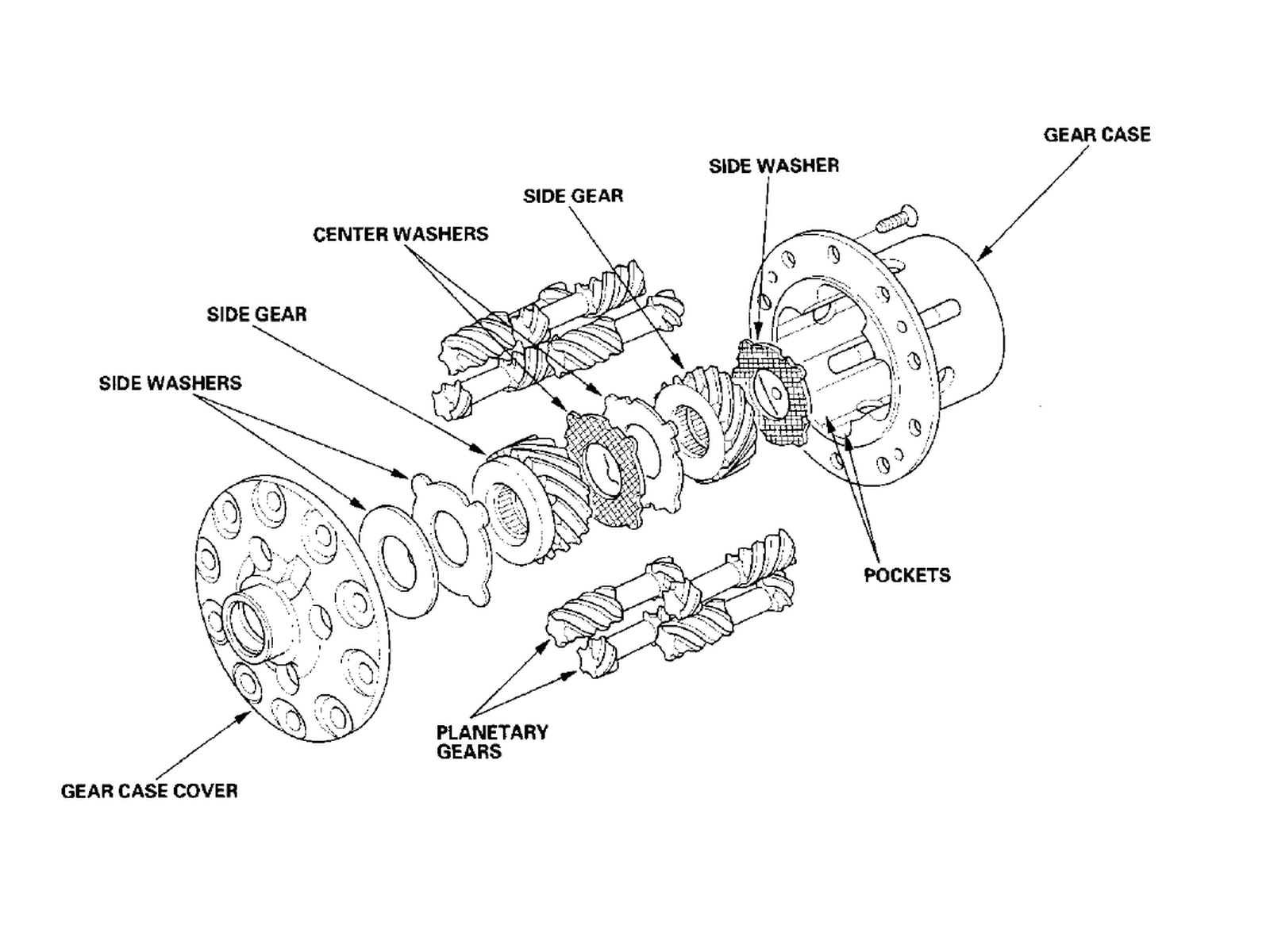
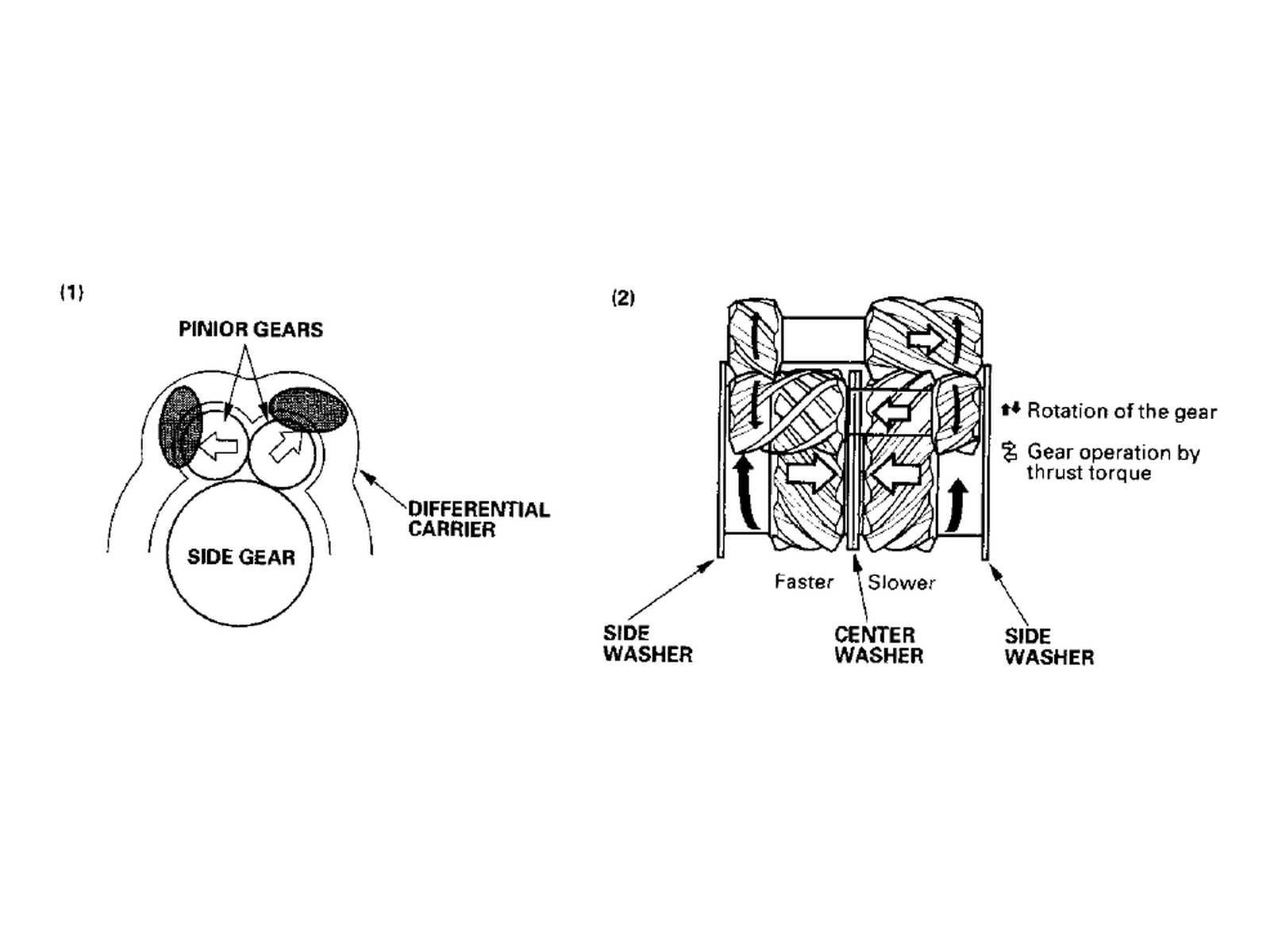
[Figures: Honda’s exploded view of the Torsen and its illustration of how the unit limits differential action.]
A circuit kerb illustrates the limit. If the inside rear wheel lifts and can support almost no drive torque, there is very little torque for the Torsen to multiply across to the outside wheel. For road use, where both tyres are generally in contact with the surface, the factory unit still offers a good balance between smooth cornering and traction. If you like the way your S2000 drives, giving that original differential some attention is a sensible place to start.
Refreshing the rear differential while keeping the factory Torsen
Open the service folder of a used S2000 and you may be able to follow every engine oil change without finding a date for the rear differential oil. Honda’s Japanese-market maintenance booklet gives 60,000 km as the differential oil change interval under severe conditions. On a 15- to 25-year-old car with an uncertain history, I would bring that job forward. I would check for leaks and confirm the oil level, then change the oil and inspect what comes out. That gives us a starting point for setting the next interval around how the car is used.
The standard housing holds around 0.8 litres. A leak takes oil out of an already small supply, and repeated hard laps can expose what remains to sustained heat. The ring gear and drive pinion mesh, and the bearings that hold them in position, all depend on that oil. A whine on the road or metal fragments in the drained oil give us a reason to look for wear or damage before deciding how far to strip the unit.
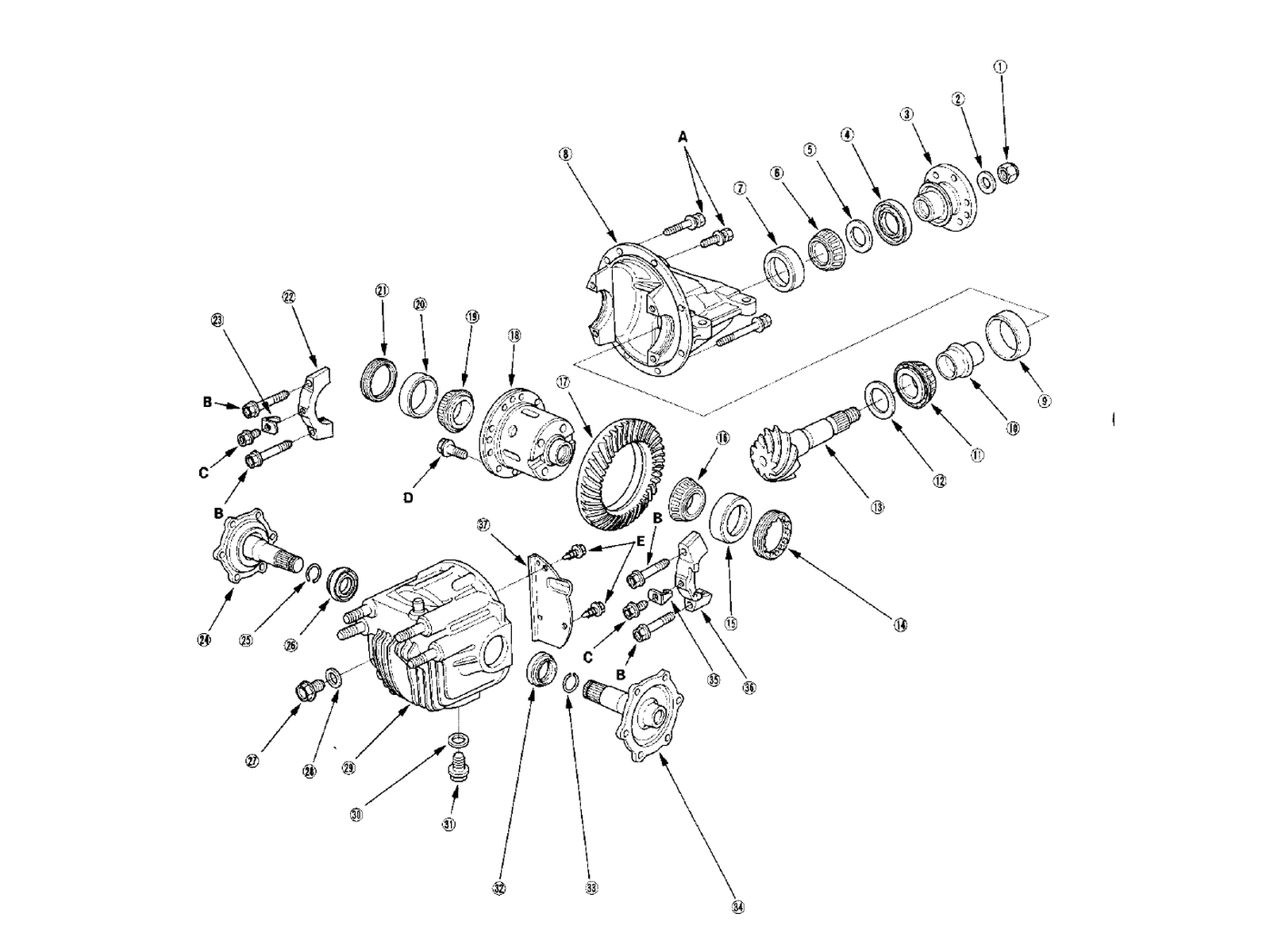
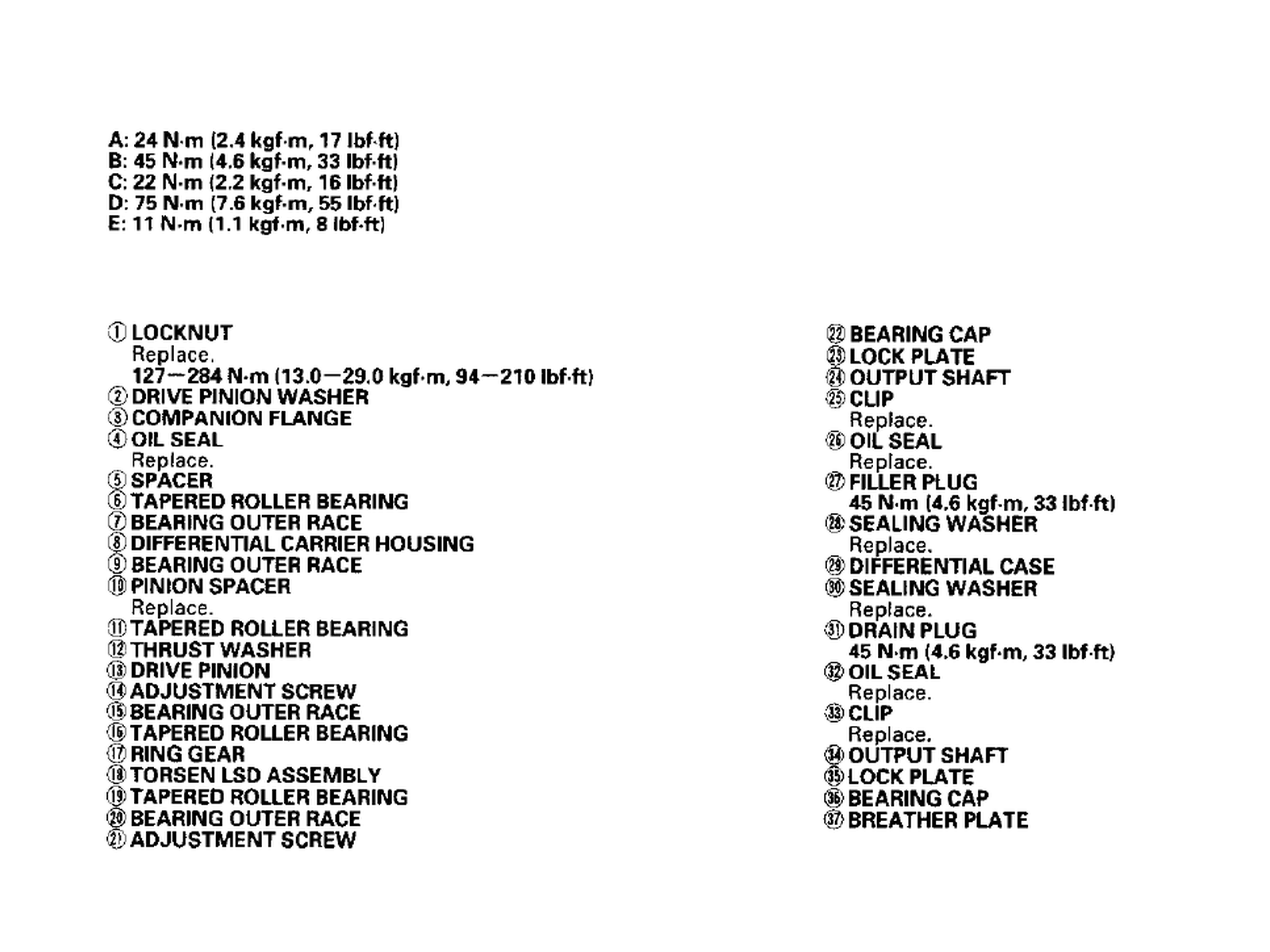
[Figures: Honda workshop manual 15-12 and 15-13 — rear differential assembly and parts key.]
The exploded view shows the Torsen diff as one unit within the complete rear differential. If it is healthy, it can go back in when we renew the bearings and seals around it. Honda’s workshop manual calls for replacement of the Torsen assembly if it has an internal fault.
Checking the ring gear tooth contact pattern with marking compound.
The orange compound in the photo shows where the ring gear and pinion teeth meet. After fitting bearings, we check their preload and measure backlash, the small amount of clearance between the teeth. The contact pattern then shows where the load falls on the tooth face. Getting those three things right is where much of the work in a differential rebuild lies.
Once the assembly is apart, last week’s discussion about final-drive ratios becomes a practical decision. If you like the action of the factory Torsen but want more pull in a given gear, or want to use a different gear between corners, you can keep the Torsen and change the final drive. A shorter ratio gives more torque at the wheels for the same engine torque in a given gear. It also raises engine revs at the same motorway speed.
Ring gear and drive pinion.
If the gearing already suits the car and the priority is managing oil temperature over repeated track sessions, the housing itself may be worth changing. The CSOhara large-capacity housing takes 2.0–2.3 litres of oil. The greater volume helps slow the rise in oil temperature under sustained load, and it also increases the amount of oil you pay for at each service. On a road car, restoring the standard housing’s seals and keeping its oil at the correct level may be all the job calls for. CSOhara large-capacity differential housing.
Standard and large-capacity housings side by side.
Depending on the build, we can also use reinforced studs at the bearing caps or a solid pinion spacer and shim to set pinion bearing preload. If the housing moves noticeably as you come on and off the throttle, I would check the mounts first. Mount rings can help control that movement. On a car that still sees plenty of road use, I would weigh that up against any extra drivetrain noise or vibration you may hear and feel in the cabin. CSOhara differential mount rings.
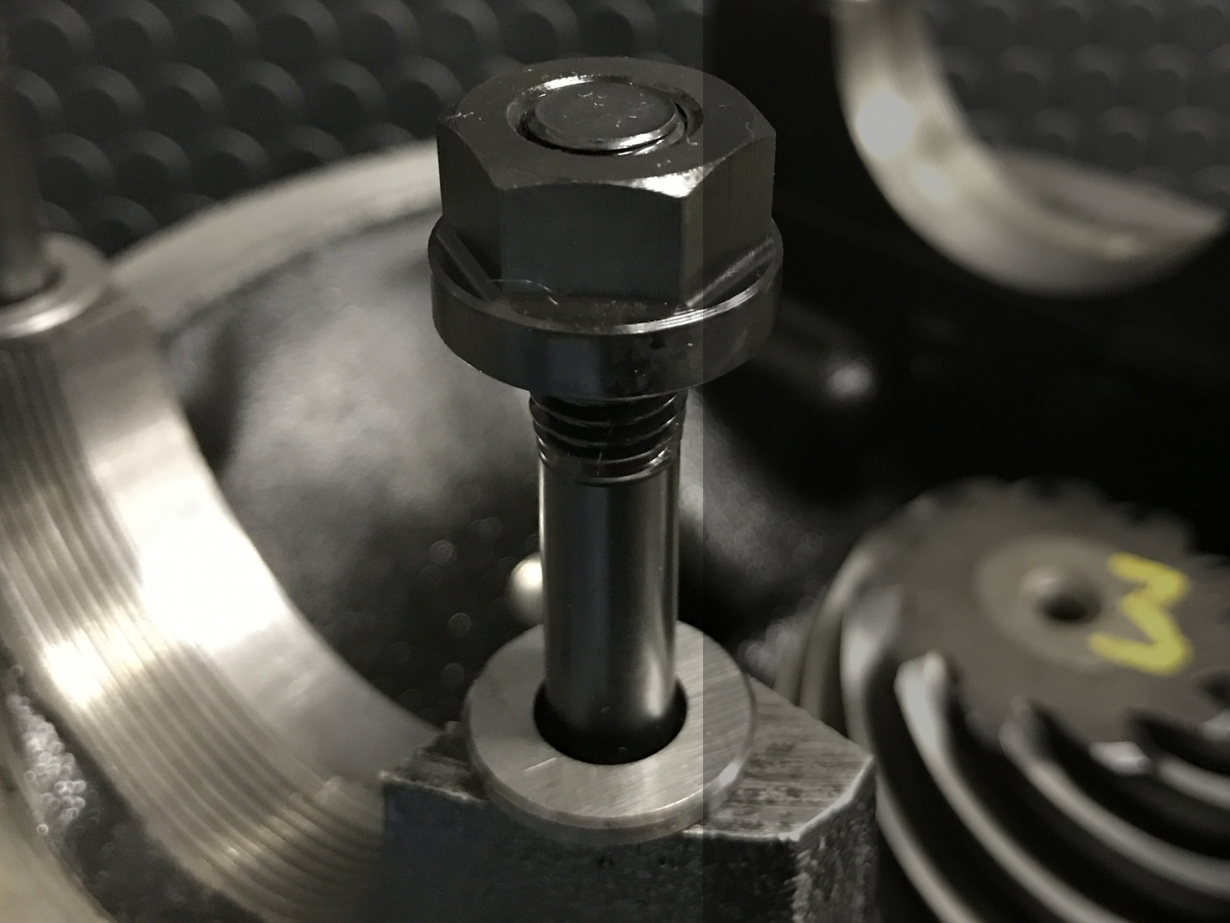
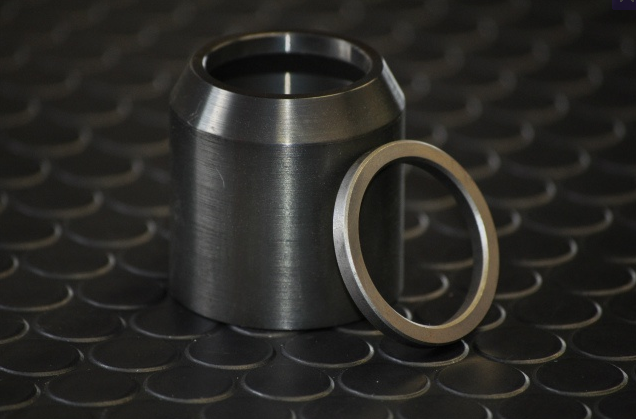
[Photos: Reinforced stud, solid pinion spacer and shim.]
A rebuild can therefore cover anything from refreshing a standard assembly to changing its gearing and increasing its oil capacity, all while retaining the factory Torsen. If the aim is to keep driving the car out of a corner when the inside rear wheel is almost unloaded, the next part to look at is the differential centre itself.
A plate-type LSD changes corner entry as well as exit
The Torsen uses the forces generated by its meshing gears to create friction. A plate-type LSD has a clutch pack on each side. Look at the stacks in the OS Giken cutaway. Alternate plates engage with the carrier and the side gear. As long as the plates can slip against each other, the rear wheels can turn at different speeds. Squeeze the plates together and their friction resists the side gear turning at a different speed from the carrier.
The pressure comes from the cam ramps. Under torque, the cross pin acts against those ramps, forcing the pressure rings apart and compressing the clutch packs. In OS Giken’s Super Lock design, springs within the pressure rings act in the closing direction at low load. The spring setting helps determine when the rings spread far enough for the clutch packs to engage more firmly.
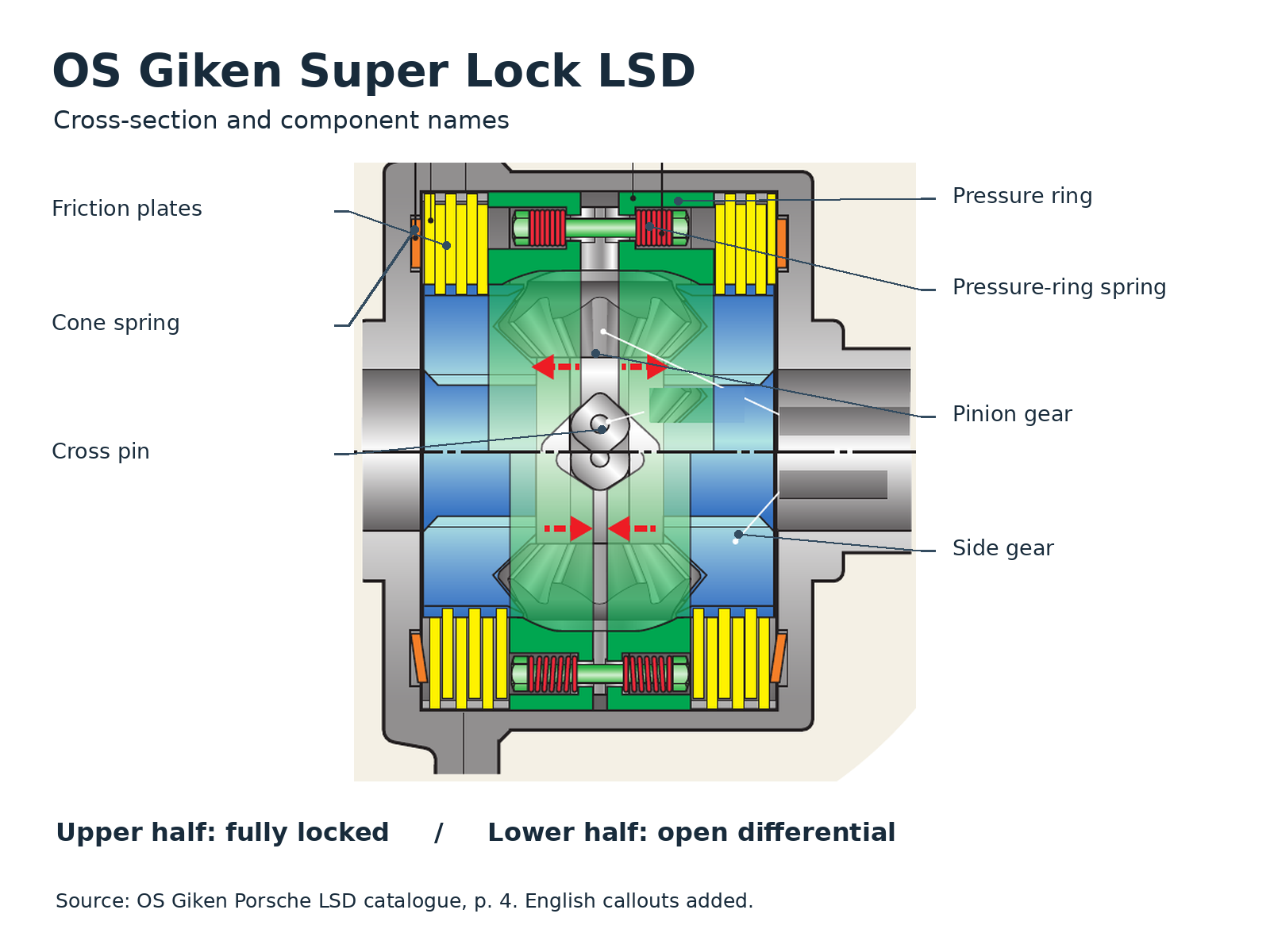
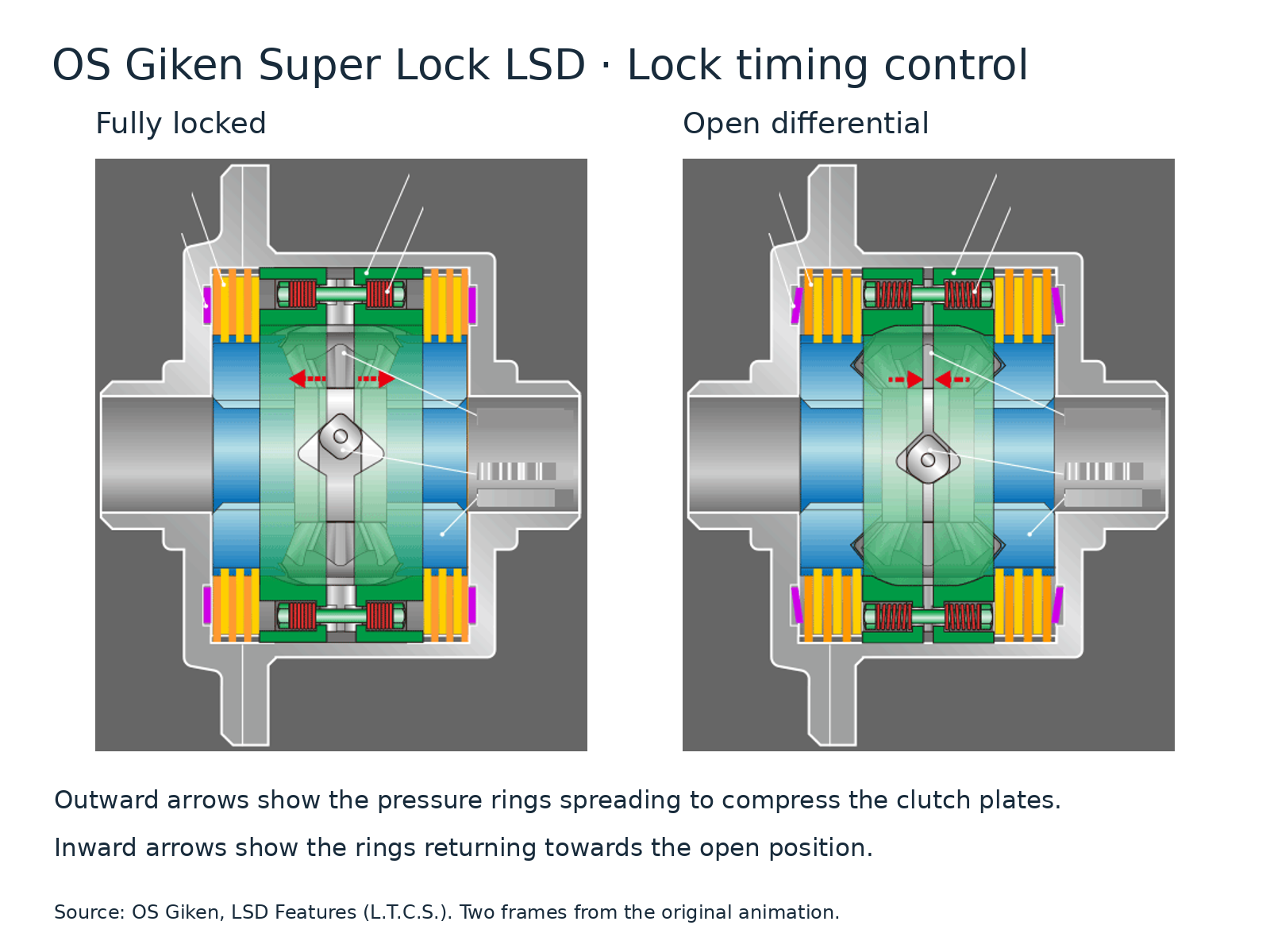
[Figures: OS Giken Super Lock cutaway, followed by the L.T.C.S. open and locked comparison.]
Think back to the corner exit, this time with the inside rear wheel light enough to lift over a kerb. The clutch pack can still resist the difference in wheel speeds, helping the outside tyre put drive down. Now picture that resistance arriving earlier, while you are still slowing down and asking the car to turn. It can settle the rear on entry. With more locking than the car needs in that phase, it can also make the car feel reluctant to change direction. That is why the drive and coast settings matter.
A 1-way uses its cam action on the drive side. On engine braking, there is essentially no coast-side cam action, which helps preserve a freer turn-in. Any clutch preload can still contribute some resistance.
A 1.5-way adds coast-side cam action at a lower level than on the drive side. It suits a driver who wants some locking on entry and stronger action when feeding the throttle back in.
A 2-way uses symmetrical ramps for drive and coast. It can build locking under engine braking as well as under power. How strongly you feel that on entry still depends on the ramp angles, preload and lock timing.
CUSCO LSD Guide, Fig. 4 — 1-way, 1.5-way and 2-way cam action with the drive-side conditions held constant.
The useful part of the comparison is the coast side, on the left. With the same drive-side conditions on the right, you can see why the three setups can feel different as you come off the throttle. The way designation describes the relationship between the ramps. The settings themselves help determine how early the diff engages and how much you feel it in a tight car park as well as on a circuit.
Why we chose a 2-way for our demonstrator S2000
If you are considering your first plate-type LSD, the words 2-way on a product page tell you very little about what you will feel in a tight turn or as you lift off on the approach to a corner. We chose a 2-way for our demonstrator so we could use and review it ourselves, then give customers something more concrete to go on before buying their first mechanical LSD.
We fitted the CSOhara-spec OS Giken Super Lock Spec-X in 2-way form. CSOhara sets the ramp angles and lock timing with the aim of letting the car turn freely as it changes direction, then bringing in the lock progressively as load builds. The demonstrator gives us a way to assess the coast-side response and the transition back onto the throttle, as well as the drive available on exit. Our demonstrator S2000 specification · CSOhara-spec Super Lock Spec-X
For an owner looking at OS Giken, Spec-S is the standard, generally available version. Spec-X is the version a specialist can configure around the car and its use. That can include the way setting, ramp angles, preload and lock timing. OS Giken offers its drive-biased 1.1-way, as well as 1.5-way and 2-way settings. A road car that sees the occasional track day and a car built around regular circuit use can call for different settings, even when they use the same basic differential.
Refilling the rear differential with the unit fitted to the car.
I would include the oil and labour for servicing when costing the conversion. Depending on what we have fitted, we use 100 km and 1,000 km as early oil-change points. After that, we recommend changing the oil in a plate-type LSD every 5,000 km. With the CSOhara housing, that means at least two litres at each change. If you are budgeting for more traction on track, those recurring costs belong in the same calculation as the parts and fitting.
How far is it worth going?
If you already enjoy the way the car turns and puts its power down, start with the oil history, leaks and any unusual noise. A healthy Torsen can stay in place while the rest of the assembly is refreshed. If the car needs a rebuild and you would like more pull in a given gear, it is a good opportunity to consider a shorter final drive. If the car repeatedly loses drive over kerbs or when the inside rear wheel unloads on track, a plate-type LSD offers a way to address that, with a corresponding change in corner-entry behaviour and servicing costs.
At TR imports UK, we can inspect and rebuild the factory rear differential, change the final-drive ratio, source an OS Giken Spec-S or help specify a Spec-X. We can also fit the replacement, carry out running-in and the initial oil change, and rebuild the original differential after removal. Depending on specification and order timing, the manufacturer’s lead time can be three to four months. We can also source CUSCO LSDs for owners who prefer them.
See the Complete S2000 Restoration
Explore the complete restoration and development of our demonstration S2000—and the workshop experience behind it: