
S2000 Fuel System Refresh, Part 2: Four Components in the Engine Bay
Fuel hose, pulsation damper, injectors and pressure regulator—renewing the parts that keep working while you enjoy the drive
Part of our Honda S2000 Restoration & Tuning Journal Series
Recently, a customer asked us to refresh four components in their S2000’s fuel system.
The fuel hose.
The fuel pulsation damper.
The injectors.
And the fuel-pressure regulator.
It is a useful opportunity to continue our earlier article, That Whirr Behind the Seats—Refurbishing the Fuel Pump Assembly.
That article took us inside the fuel tank. This time, we follow the fuel into the engine bay.
Our subject is a refresh using genuine Honda components. The objective is to keep an ageing S2000 working properly for the years ahead.
The photographs accompanying this article show the work carried out on our own demonstration S2000 in 2023. They illustrate the components and process; they are not photographs of the customer’s current project.
The fuel-system components around the intake manifold of our demonstration S2000, photographed during its 2023 refresh.
1. Follow the Fuel
Let us begin with the journey.
Petrol enters through the filler neck and reaches the tank. The pump draws it through the strainer and sends it through the filter and fuel lines towards the engine.
In the engine bay, the fuel hose connects the supply to the fuel rail, which distributes fuel to the four injectors.
The injectors open when instructed by the engine control unit, delivering fuel into the intake ports.
On the return-type arrangement fitted to our demonstration car (AP1-130 2005 UKDM), the fuel-pressure regulator controls pressure at the rail, allowing surplus fuel to return to the tank.
The pulsation damper has a different job. It cushions pressure fluctuations within the supply system, including those associated with the injectors opening and closing.
These components work together.
A healthy pump is important, but it is only one part of the journey between the tank and the combustion chambers.
2. No Replacement Interval Does Not Mean No Ageing
Many owners are familiar with scheduled maintenance.
Engine oil, filters, spark plugs and coolant have a place in the service history. The four components discussed here are less likely to appear as routine replacement items.
Nevertheless, they have been working for many years.
The newest S2000s are now around 17 years old. Earlier cars have passed 25.
A rubber hose does not remain young because the odometer has barely moved. Nor does a mechanical component stop ageing simply because nobody has recorded a fault.
Mileage is part of the assessment. Storage conditions, periods of inactivity, previous work and the car’s present condition matter too.
For a long-term owner, there is also the question of parts supply.
I would rather consider suitable genuine replacements while we can still obtain them than leave every decision until a failure forces the issue.
That does not require replacing everything in one visit. It requires knowing what has already been done and planning what comes next.
3. The Fuel Hose: More Than a Piece of Rubber
The fuel hose carries pressurised petrol into the engine-bay supply system.
It lives with heat, vibration and repeated changes in operating conditions. Its rubber sections and connections deserve attention as the car ages.
An owner may look at an old hose and say, “It is not leaking.”
That is useful information about its present condition. It does not tell us how much service life remains.
When planning a thorough fuel-system refresh, I would consider the age of the hose and its replacement history alongside a physical inspection.
For our demonstration car, we fitted a new genuine Honda assembly.
It is a modest-looking part. Once installed, it attracts very little attention.
That is the nature of much preventative maintenance: the value is in continuing to use the car without the component becoming the reason a journey stops.
The genuine Honda fuel-hose assembly prepared for installation on our demonstration S2000.
4. The Pulsation Damper: A Small Component with a Continuous Job
Fuel delivery is not perfectly steady.
The injectors repeatedly open and close, producing pressure fluctuations within the system. The pulsation damper helps cushion those fluctuations.
It is easy to overlook because it is small and does not announce its work to the driver.
However, its internal mechanism has spent years responding to the operation of the fuel system.
During our refresh, we renewed it as part of the same project.
The reasoning is straightforward. We were attending to the fuel supply around the rail, and this was another original component whose age belonged in that assessment.
The damper and pressure regulator are sometimes confused. They serve different purposes: one cushions pulsations; the other regulates fuel pressure.
5. The Injectors: Clean Them or Replace Them?
The injectors are the final metering components in this fuel-delivery route.
The ECU determines when they open and for how long, using information about engine operation. Their ability to deliver fuel consistently therefore matters to how the engine runs.
Deposits can affect an injector’s flow and spray pattern.
Professional cleaning and testing are useful options. They can help establish the condition of an existing set and address contamination. We have regularly outsourced cleaning jobs to our partner specialists.
For this project, however, the decision was to fit genuine new injectors.
Cleaning an existing component and renewing the component itself are different approaches. Cleaning can address deposits; replacement also renews the ageing injector assembly.
The choice belongs in the owner’s longer-term plan, together with the condition of the existing injectors and the availability of the correct replacements.
S2000 specifications differ by production period and market. We identify the appropriate injector for the car rather than assume that one part suits every S2000.
Our website includes separate fuel-injector project pages for the relevant applications. Parts availability needs to be checked when planning the work.
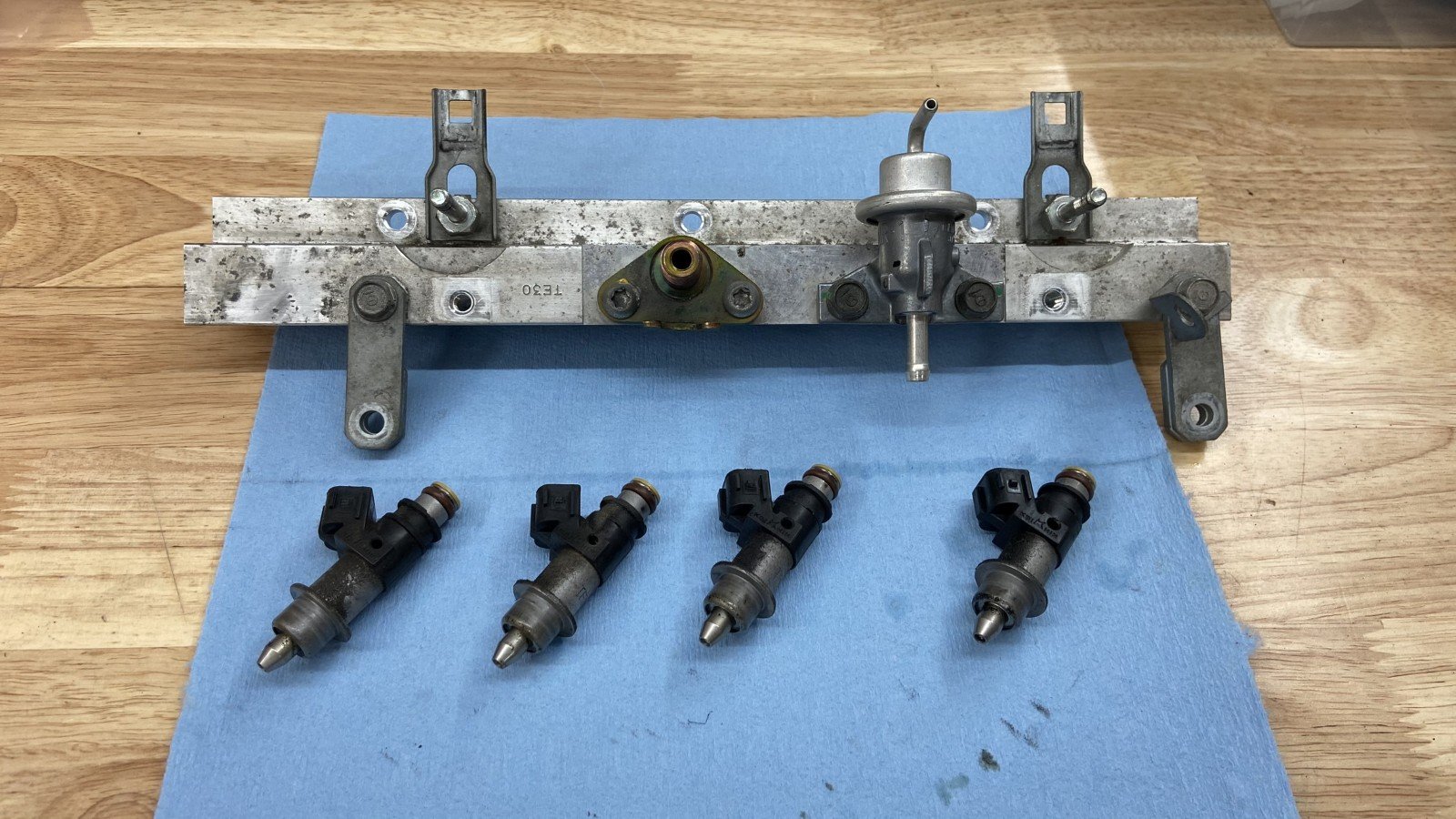
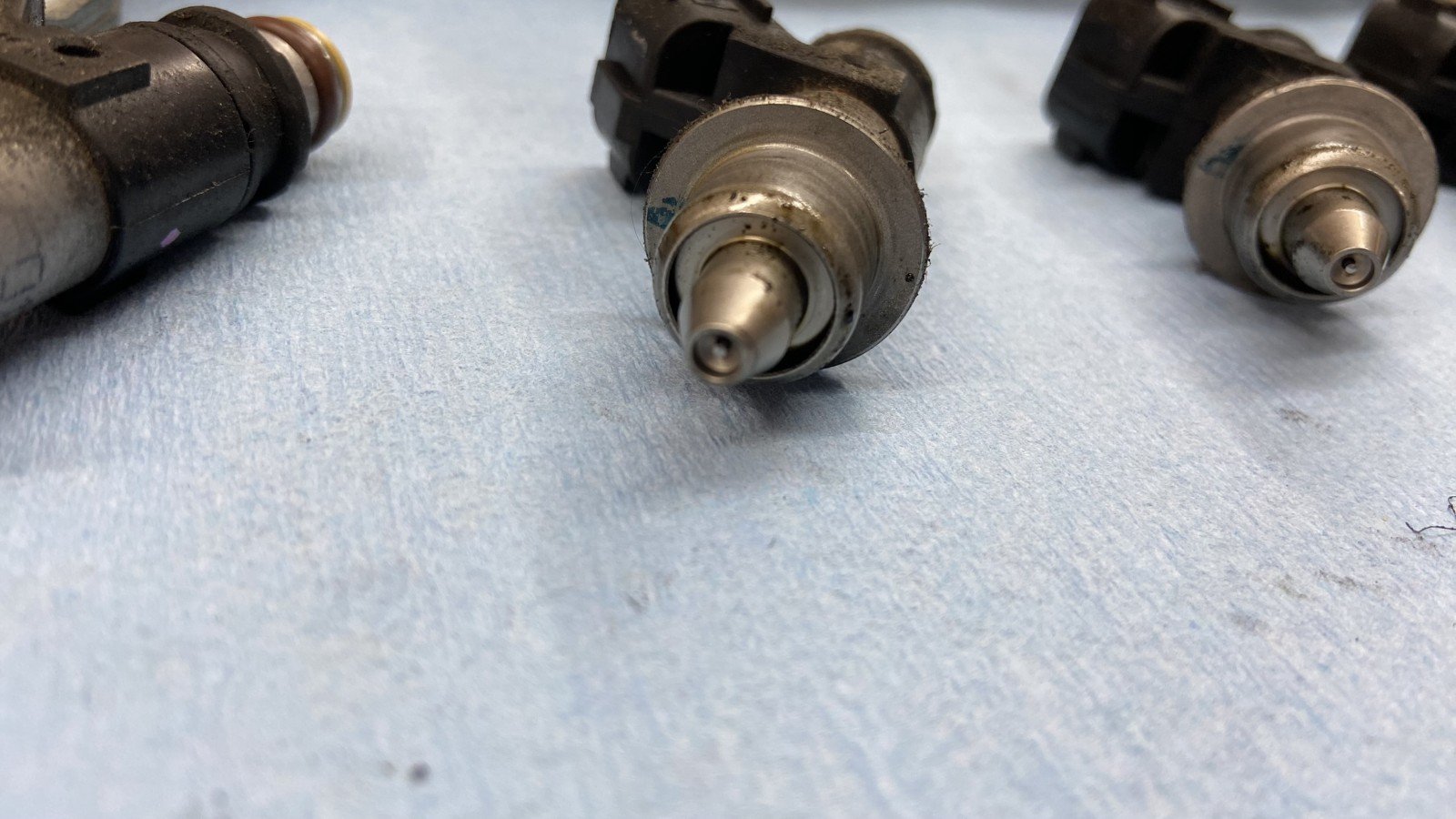
The removed fuel rail and injectors from our demonstration car. Dismantling gives us an opportunity to inspect the injectors, their seating areas and the surrounding components.
New genuine injectors and sealing components prepared for reassembly.
The seals deserve attention too.
A fuel-system refresh should include the appropriate O-rings, sealing rings and other replacement items required for the assembly. New injectors are only part of a properly completed job.
6. The Fuel-Pressure Regulator: Supporting the Injector’s Work
An injector’s delivery depends on more than its opening time.
Fuel pressure also matters.
On our demonstration car, the regulator responds to intake-manifold pressure and controls the pressure difference across the injectors. Surplus fuel returns to the tank. (AP1.5 and AP2 vehicles have their regulator in a different place - inside the fuel tank.)
It is a mechanical component, with internal parts that have been working throughout the car’s life.
Again, our purpose was to renew the standard arrangement.
We were not fitting an adjustable regulator or increasing fuel pressure as a tuning exercise. We wanted the original system to continue doing its job properly.
The removed fuel-pressure regulator alongside its genuine Honda replacement.
Once the components are installed, the work continues with checks for leakage and correct operation.
The engine must start, idle and respond properly. The connections and sealing points must remain dry.
Fitting the final part is not the end of the refresh.
The fuel-system components reassembled on our demonstration S2000.
7. A Known Maintenance History Helps When Something Goes Wrong
Fuel delivery is part of a larger system.
The ECU uses sensor information to control injection and ignition. The fuel supply, intake system, sensors and ignition components all need to perform their respective jobs.
When something goes wrong, the driver may notice a warning light, uneven idle, misfire or hesitation during acceleration.
Those symptoms begin an investigation. They do not identify the failed component by themselves.
This is where a well-maintained car gives us a better starting point.
We know which parts have been renewed.
We know what has been inspected.
We know how the car behaved afterwards.
Compare that with a 20-year-old S2000 whose maintenance history is largely unknown. Several ageing systems may need investigation, and diagnosis can become a sequence of checks, dismantling, repairs and further checks.
That takes time and costs money.
Our earlier article, When the Prime Suspect Was Me—Diagnosing Idle Hunting on Our Honda S2000, showed this process in practice.
Much of the intake system had already been refreshed. We could use that history during the investigation, even though finding the actual cause still required work.
Preventative maintenance does not remove the need for diagnosis. It builds a clearer history around the car.
That history becomes increasingly valuable as the S2000 grows older.
8. What Does a Well-Maintained S2000 Feel Like?
Have you driven a friend’s S2000 that has been carefully maintained?
Perhaps the engine settles into idle more cleanly.
Perhaps its response feels smoother.
Perhaps the whole car feels more together than you expected.
Individual cars can feel surprisingly different, even when their basic specifications are similar.
The changes in our own car happen gradually. We become accustomed to its behaviour, and we may not recognise what has changed until we drive another example.
That is one reason I enjoy developing and maintaining our demonstration S2000. It gives us a car whose history we know and whose changes we can follow.
If your paintwork, wheels and engine-bay appearance are already where you want them, consider the components that remain out of sight.
They are still working every time you drive.
A fuel hose is unlikely to attract compliments at a car meet. New injectors and a pressure regulator may barely be noticed.
For an owner who intends to keep enjoying an S2000, they can nevertheless be worthwhile parts of the project.
9. What Has Already Been Done on Your S2000?
Start with the service history.
Has the fuel pump been replaced?
Are the engine-bay fuel components still original?
Has anyone tested or renewed the injectors?
What else has been refreshed around the intake and ignition systems?
You do not need to answer every question by ordering every available part.
Bring together what you know about the car, how you use it and how long you intend to keep it. Then decide the priorities.
If you would like help planning that work, tell us about your S2000—its year, mileage, maintenance history and any symptoms you have noticed.
We can assess the starting point and build a refresh plan around the car you want to continue enjoying.
See the Complete S2000 Restoration
Explore the complete restoration and development of our demonstration S2000—and the workshop experience behind it: