
From restoring the original feel to sharpening feedback with spherical bearing bushes.
Part of our Honda S2000 Restoration & Tuning Journal Series
Last week, we looked at the S2000’s rear differential: how the factory Torsen works, why servicing matters, and what changes when you fit a plate-type LSD. The subject was how the car uses engine torque at the two rear tyres.
This week, we turn to the information coming back from the road.
The steering’s response as you turn into a corner. The way the rear settles as you feed in the throttle. How the body moves after crossing a bump. We use those sensations to judge what the car is doing and decide what to do next.
Suspension bushes help shape that conversation.
You may have chosen your coilovers carefully, tried different tyres and paid attention to alignment. But have the bushes supporting the suspension arms received the same attention? On an S2000 now 15–25 years old, they deserve inspection before the next round of upgrades.
We will start with what a bush does, then explore the choices available—from restoring the original feel to making feedback more direct with spherical bearings.
A suspension arm needs support—and freedom to move
When a tyre travels over a bump, the suspension arms move relative to the body. Fix those arms solidly in place and the suspension cannot work. Leave them loose and they cannot hold the wheel in its intended position or transmit braking, cornering and acceleration forces properly.
The bushes at the mounting points provide that connection.
A conventional original-equipment rubber bush has a metal inner sleeve and a metal outer sleeve, with rubber bonded between them. The mounting bolt secures the inner sleeve. As the outer sleeve moves with the arm, the rubber twists to accommodate suspension movement.
The rubber also helps isolate vibration and noise from the cabin. Its flexibility is part of the design.
However, its condition changes over time. Repeated loading, movement, heat and exposure can lead to hardening, cracking or separation at the bonded surfaces. Significant deterioration can compromise the support provided to the arm and eventually become a safety concern.
For this discussion, the S2000 has 22 suspension bush locations:
Each is a small component, but together they support the way the suspension works.
In our September alignment article, we discussed seized adjusting bolts. The same issue matters when planning a bush replacement. We need to inspect the bolts and arms alongside the bushes, rather than deciding how many new bushes to order before checking what is already on the car.
Read our S2000 wheel alignment and seized adjusting bolts article.
Four choices when replacement becomes necessary
Finding a deteriorated bush does not automatically make spherical bearings the next step. There are four broad options: genuine Honda rubber, reinforced rubber, polyurethane and spherical bearing bushes.
Genuine Honda bushes remain available for many locations, with some exceptions. Early rear upper-arm bushes, for example, were never supplied separately. We therefore check the particular car and mounting location before planning the work.
If you enjoy the S2000’s original character and want to keep it, fresh genuine bushes can be a worthwhile choice. After years of driving on ageing rubber, it is easy to forget how a healthy original bush should behave.
Reinforced rubber bushes, including options from MUGEN and SPOON SPORTS, offer another direction. They retain rubber as the material accommodating movement while reducing deformation under load. The choice becomes a balance between isolation and response.
Polyurethane bushes are also familiar to British owners. Their behaviour depends on more than the material name, though. Hardness, shape, sleeve design and lubrication requirements vary between products. The maintenance needed after installation belongs in the decision alongside the initial purchase price.
Then there are spherical bearing bushes, often called pillow-ball bushes in Japanese tuning literature.
These use a spherical bearing to accommodate movement at the connection. To understand what changes, let us take one apart.
What moves inside a spherical bearing bush?
Photo: The assembled spherical bearing bush.
Viewed from the outside, the assembly has a central bolt hole surrounded by metal components. It might initially look as though we are replacing a flexible mounting with a solid lump of metal.
First, we remove the collars from either side.
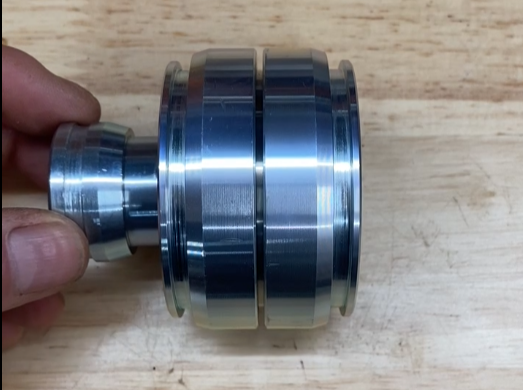
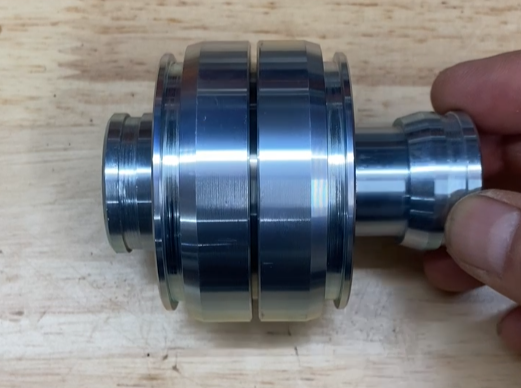
The collars connect the centre of the bearing to the vehicle’s mounting arrangement. Removing the surrounding components reveals the spherical bearing itself.
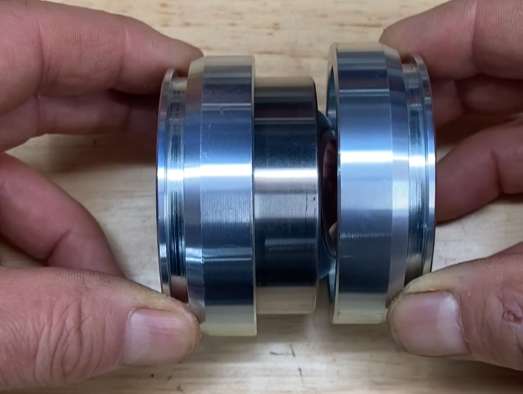
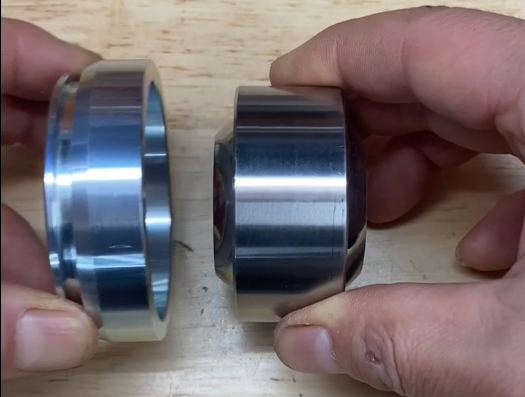
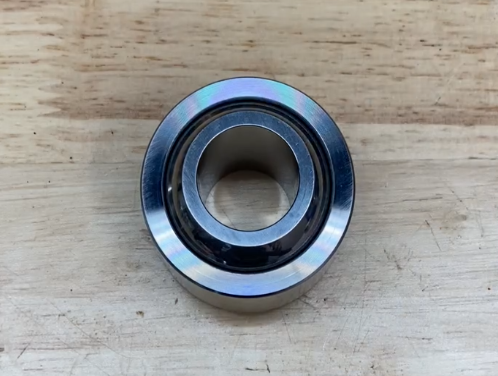
Look closely at the inner ring—the part with the hole through its centre. Its outer surface is spherical, supported within the outer ring. Tilt the inner ring and it changes angle within that spherical interface.
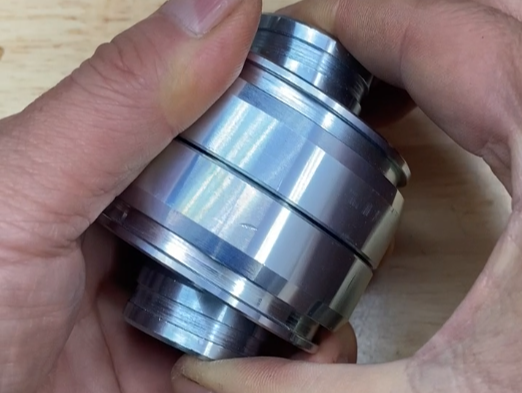
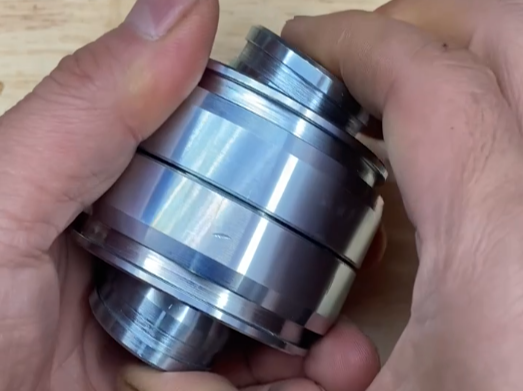
That movement allows the connection to accommodate the changing angle of the suspension arm.
In a rubber bush, deformation of the rubber permits movement. In a spherical bearing bush, the bearing provides the articulation. A correctly specified bearing in good condition allows the necessary movement while limiting unwanted displacement under load.
This is the basis of the more direct response.
Reducing compliance at a connection changes how forces and movement pass through the suspension. For a driver interested in small differences in response, this can make the car’s behaviour easier to distinguish.
However, the additional information reaching the cabin may include noise and vibration previously softened by the rubber. The result depends on the location, the product and the rest of the suspension.
I would therefore choose spherical bearings around the feedback you want and the sensations you are happy to live with—not simply because the components are made from metal.
Spherical bearings wear too: the liner and the dust boots
It is tempting to assume that a metal bearing can remain in service indefinitely. Spherical bearings are wearing components too.
CUSCO describes its adopted bearing design as using a self-lubricating PTFE liner at the spherical sliding interface. That liner helps accommodate movement, but repeated use causes wear. Future inspection and replacement should therefore form part of the decision to fit spherical bearing bushes.
Now look at the black rubber components around the bearing in the installation photographs.
These are dust boots. Their job is to help protect the bearing from water, grit and other contamination. They serve a different purpose from the liner inside the bearing.
Inspection needs to cover both.
We check the boots for cracking, splitting or displacement, and the bearing for play and changes in its movement. A clean exterior does not prove that the internal bearing remains unworn.
Noise also needs careful interpretation. A more direct mounting can transmit sound without the bearing being loose, while internal wear can itself produce knocking. CUSCO identifies internal component wear as a possible cause of noise and advises replacement of the affected bearing or assembly when necessary.
The appeal is more direct feedback. The responsibility is to monitor the components and replace them when their condition calls for it.
Start with selected locations
By this point, you may be picturing all 22 bushes replaced with spherical bearings.
For a first installation, I would usually suggest starting with selected locations. Provided the remaining bushes are healthy, this gives you a chance to understand the change before deciding whether to go further.
Three areas are worth considering.
The four damper-to-lower-arm connections
The lower end of each damper connects to its lower arm through a bush. This mounting sits directly in the path between suspension-arm movement and the damper.
A spherical bearing reduces rubber deformation at that connection while accommodating the required angular movement. It is a way of considering the mounting alongside the springs and dampers you have already chosen.
The front caster bushes
These support the front lower arms at the mounting points involved in caster adjustment. They matter when considering how the arms hold position under forces such as braking, as well as during steering inputs.
Reducing compliance here can make the front suspension’s response more direct. It also connects with our earlier alignment discussion: measuring an angle with the car stationary is one part of the picture; how the mounting behaves under load is another.
The rear control arms
These help control rear toe. Again, the question extends beyond the alignment reading obtained while the car is stationary.
Their mounting compliance contributes to how the rear suspension responds as loads change. For an owner seeking a clearer sense of the rear of the car during steering and throttle transitions, this is another area to consider.
We can supply the components for these locations and discuss installation as part of a wider suspension plan.
The condition of the remaining bushes is essential, though. Replacing selected connections will not compensate for deterioration elsewhere. Necessary restoration work comes first, with upgrades chosen around a sound foundation.
Making changes in stages also helps you understand them. Replace many components at once and it becomes harder to identify which change produced the sensation you enjoy—or the one you would prefer to avoid.
Restore the original feel, or explore something further?
Bush replacement is rarely a visible upgrade. You will not notice it when opening the bonnet, and someone walking around the car may never know the work has been done.
Yet these small connections help shape what reaches the driver.
If you like the original S2000 character, replacing tired bushes with genuine parts can restore the foundation you want. Reinforced rubber offers a way to reduce compliance while retaining rubber isolation. Spherical bearings provide another route for owners seeking a more direct connection.
For drivers who enjoy noticing small changes in handling, this is an opportunity to explore the S2000 from a different angle to spring rates and damper settings.
The number 22 does not decide the scope of the job. The condition of the car, its road and circuit use, your tolerance for noise and vibration, and the direction you want to take all matter.
At TR imports UK, we can discuss inspection, component selection, replacement work and alignment as one project. Whether you want to refresh the original suspension or explore a selective spherical bearing installation, tell us about your current setup and how you use the car.
See the Complete S2000 Restoration
Explore the complete restoration and development of our demonstration S2000—and the workshop experience behind it: