
Importing Cars and Parts from Japan: 0% Duty? Not So Simple.
Why the UK–Japan trade agreement is not a blanket duty exemption for your next purchase
“Import from Japan and pay 0% duty.”
If you are looking for a Copen or ordering replacement parts, that sounds like welcome news.
But it leaves out the question that matters: does your purchase qualify, and can the claim be supported?
The UK–Japan trade agreement provides preferential tariffs for qualifying goods. It does not make every car or part bought in Japan duty-free.
Presenting the first point without the second is misleading. It can encourage you to commit to a purchase using a saving that has not been established.
Let us look at where the misunderstanding comes from—and what it means for the cars and parts we actually buy.
CEPA Was Not Designed to Promote Personal Imports
The UK–Japan Comprehensive Economic Partnership Agreement—CEPA—was not designed as a scheme to encourage individuals to buy used cars or replacement parts from Japan.
It is a wider trade agreement supporting business between the two countries, including manufacturers, exporters and their supply chains.
Reducing tariffs can help a manufacturer import components or sell finished products overseas. The direct saving initially benefits the business paying those costs.
It does not automatically become a lower retail price for you. The agreement does not require manufacturers or distributors to pass the saving on.
Much of this industrial trade concerns newly manufactured products. The agreement also covers qualifying used goods, but it was not built around the practical circumstances of buying a second-hand Copen at auction.
Individual imports can benefit when the conditions are met. That is quite different from a general invitation to buy anything from Japan without paying duty.
Nor should you expect genuine parts sold through established UK distribution channels to become cheaper simply because a preferential tariff is available.
A Japanese Car Is Not Automatically a Qualifying Car
A Copen was manufactured in Japan. Surely that settles the question?
For CEPA, we need to establish more than its place of manufacture.
The agreement has rules determining whether a product qualifies as originating. These can consider the materials used, their origins and values, and the manufacturing processes involved.
A used car must have met the relevant origin requirements when it was new and retained its originating status during use.
That brings us to the practical problem.
When we buy a Copen at auction, we receive information about the car as it exists today: its registration year, mileage, condition, equipment and repair history.
The auction sheet does not tell us the proportion of non-originating materials used to manufacture it.
The seller can sell us the car. That does not mean the seller can also supply the manufacturer’s records needed to support a preferential-origin claim.
This is why “made in Japan” and “eligible for 0% duty under CEPA” should not be treated as interchangeable descriptions.
Do Genuine Parts Make It Easier?
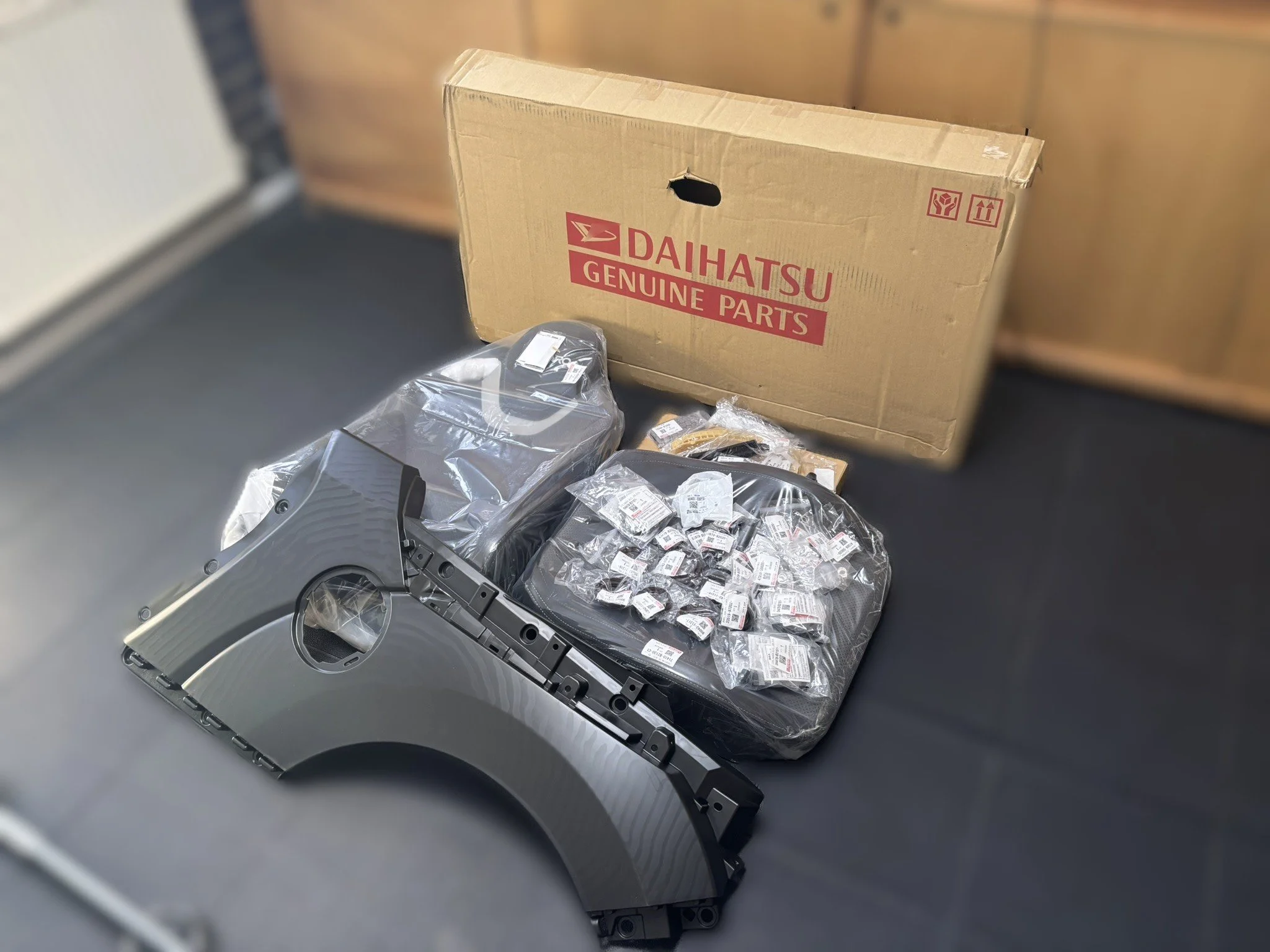
Genuine Daihatsu parts sourced for our workshop. Supplying the parts and supplying the evidence for a CEPA claim are separate tasks.
Buying new genuine parts brings us back to the same difficulty.
To support a CEPA claim, the applicable origin rule must be satisfied. Depending on that rule, the evidence can include manufacturing details and figures showing the proportion of non-originating materials.
Our supplier can identify the correct part, confirm its price and supply it.
However, the manufacturer’s production and material-cost records do not normally arrive with the parts invoice.
A genuine-parts label and a part number identify what we have bought. They do not provide the manufacturing evidence needed for every preferential-origin claim.
We can therefore obtain the part without necessarily obtaining the information required to support 0% duty.
That leads to the declaration used to make the claim.
What Is the CEPA Declaration?
The exporter’s statement on origin, often called a CEPA declaration, declares that the goods meet the agreement’s origin rules.
The exporter places the prescribed wording on an invoice or another commercial document identifying the goods. The exporter must have information supporting that declaration.
Simply asking a supplier to add the wording does not fill a gap in the manufacturing evidence.
The sequence matters: establish that the goods qualify, obtain the supporting information, and make the declaration.
The statement communicates the conclusion. It does not replace the evidence behind it.
There is a statement-on-origin waiver for qualifying imports from Japan valued below £1,000. UK government guidance states that this waiver does not remove the requirement for the goods to meet the rules of origin.
Why “0% Duty” Advice Needs a Closer Look
Online import guides sometimes describe 0% duty alongside a requirement for proof of preferential origin.
That condition is the important part.
If the headline rate is repeated while the condition disappears, the reader receives a different message: buy a Japanese car and the duty saving follows automatically.
It does not.
Equally, a report that a shipment cleared with no duty tells us the outcome of that shipment. It does not, by itself, explain the basis of the declaration or establish that your next purchase will receive the same treatment.
For claims requiring origin documentation, the agreement also provides for supporting records and subsequent checks. Receiving the goods is not a substitute for having a supported claim.
The useful question to ask an importer or supplier is therefore:
“What supports the 0% duty included in this quotation?”
A clear answer helps you understand the figure. A headline alone does not.
What Difference Can It Make to Your Budget?
The difference is worth taking seriously.
For a conventional passenger-car import subject to the standard 10% duty rate, a customs value of £10,000 produces £1,000 in duty.
Import VAT is also calculated on the duty, so removing that £1,000 reduces VAT by a further £200 in this simplified example.
The total difference is £1,200.
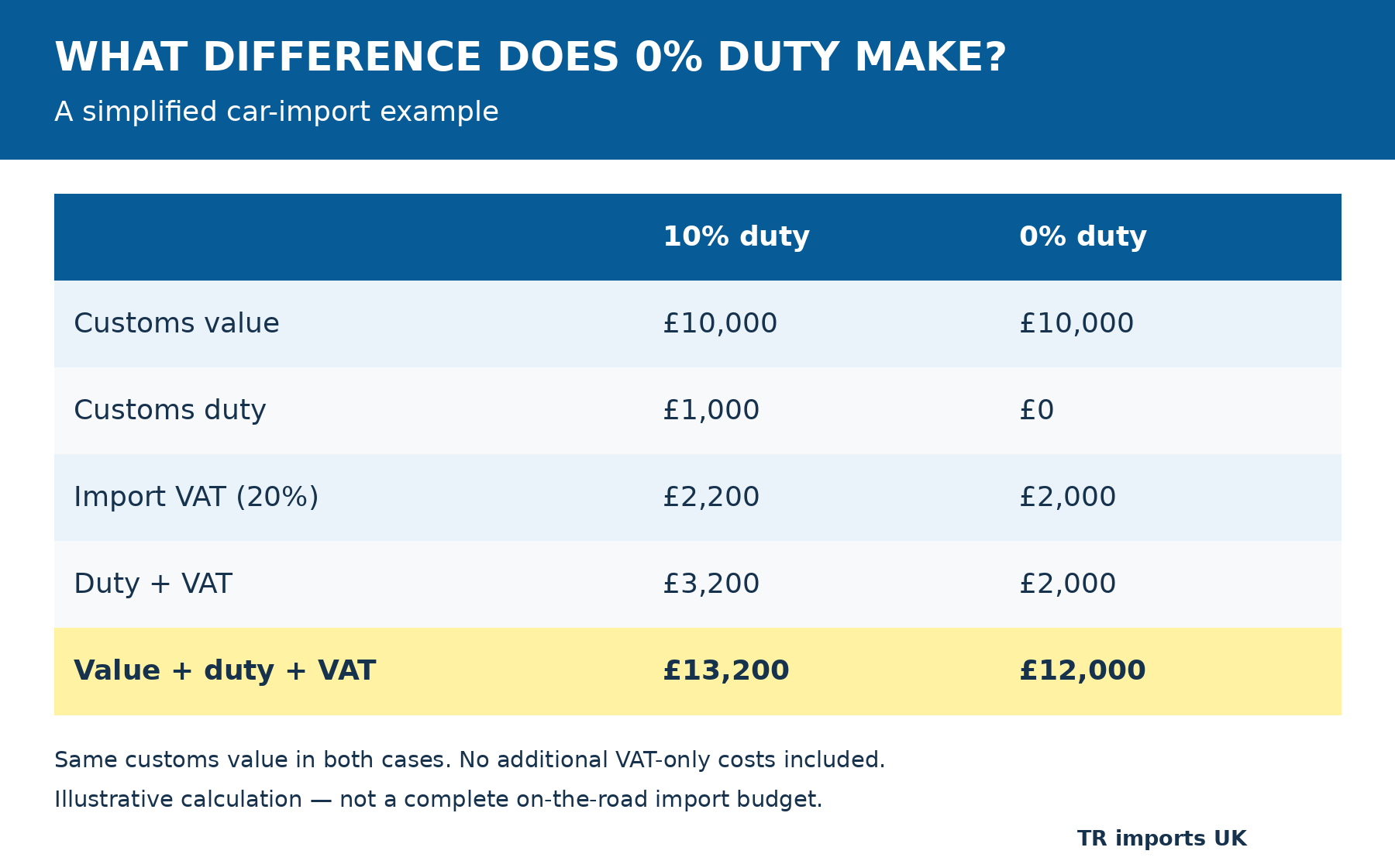
Both examples use a customs value of £10,000 and 20% import VAT, with no additional VAT-only costs included. This illustrates the tax difference rather than a complete on-the-road budget.
That is a meaningful amount of money. It is also too much to treat as a saving before the duty treatment has been established.
Parts require their own calculation. Their standard duty rates depend on the commodity classification; the passenger-car rate should not be applied to every box of automotive parts.
And 0% duty does not mean 0% import VAT.
The Headline Is Not Your Total Import Cost
In our previous article, Before You Import a Copen, we looked at the decisions needed before committing to a car in Japan.
This is another of those decisions.
The purchase price, Japanese fees, transport, shipping, taxes, UK registration and preparation all contribute to the amount you will spend.
A duty saving can help. It does not tell you what condition the car will be in when it reaches you, or what work it will need before you can enjoy it.
Start with a complete budget and a clear description of what is included. Where preferential duty has been established, include it. Where it has not, leave room for the standard duty applicable to the goods.
You can then decide what you can afford using figures that have a basis.
Before You Buy, Check What the Claim Means
CEPA creates real opportunities for trade between Britain and Japan.
The misinformation begins when those opportunities are presented as an automatic duty exemption for anything an individual buys from Japan.
For a used car, the difficulty is obtaining evidence about how it was manufactured. For replacement parts, identifying and purchasing the correct item does not necessarily provide that evidence either.
The declaration must follow a supported conclusion—not create one.
If you are planning to import a Copen, tell us what you are looking for through our Bespoke JDM Import enquiry form. We can discuss the car, the import costs and the preparation you want before you commit to a purchase.
Check the basis of the saving before you spend it.